
- Budget the full project, not only software subscriptions or the integrator proposal.
- Scope, integrations, data quality and internal capacity are the biggest cost drivers.
- Compare every bidder against the same scope, assumptions and exclusions.
- Use five-year total cost of ownership to compare ERP options on a consistent basis.
How much should a company budget for an ERP implementation in Quebec? As early-stage planning ranges used by PlanAxion, a limited single-entity cloud ERP project may represent roughly CAD 150,000 to 400,000 in the first year. A mid-market manufacturing or multi-site project often lands around CAD 400,000 to 1.5M. A complex transformation can exceed CAD 1.5M.
These are planning ranges, not quotes. Actual cost depends on scope, modules, entities, integrations, data quality, compliance requirements and the amount of work performed by internal teams.
The number to compare is not the software subscription alone. It is the total cost of ownership over the life of the ERP.
What should an ERP implementation budget include?
A complete ERP budget should make eight cost lines visible.
- Software and modules: users, roles, finance, manufacturing, procurement, warehouse, analytics and environments.
- Implementation services: design, configuration, project management, testing, cutover preparation and support.
- Internal time: finance, operations, IT, data owners, process owners and super-users.
- Data: cleanup, deduplication, conversion, archiving and test loads.
- Integrations: EDI, ecommerce, banking, payroll, carriers, MES, WMS, CRM and BI.
- Reporting and controls: security, segregation of duties, dashboards and regulatory reporting.
- Training and adoption: role-based training, procedures and manager support.
- Stabilization: first financial closes, priority fixes, hypercare and operational adjustments.
What planning ranges are useful?
| Typical scope | Early planning range | Main cost drivers |
|---|---|---|
| Single entity, standard cloud scope, few integrations | About CAD 150K–400K in year one | Modules, users, migration effort and partner services |
| Several functions or sites, mid-market complexity | About CAD 400K–1.5M | Integrations, multi-site processes, data and internal capacity |
| Complex manufacturing or multi-entity transformation | CAD 1.5M+ | Process complexity, multiple entities, advanced integrations and change effort |
Two companies of similar size can have very different budgets. The biggest differences usually come from data quality, the number of interfaces, how far processes diverge from standard ERP capability and how much internal capacity is available.
What drives ERP implementation cost upward?
The biggest cost drivers are scope, number of entities and sites, integrations, data condition, customization and internal availability.
- More processes and modules in the first release.
- More legal entities, sites, countries or currencies.
- More integrations or poorly documented interfaces.
- Dirty master data and large migration histories.
- Custom extensions that increase design, testing and support effort.
- Slow decisions or limited availability from business teams.
Uncertainty is expensive. A requirement that is unclear before signing often turns into analysis, rework, change requests or custom development during implementation.
How should ERP proposals be compared?
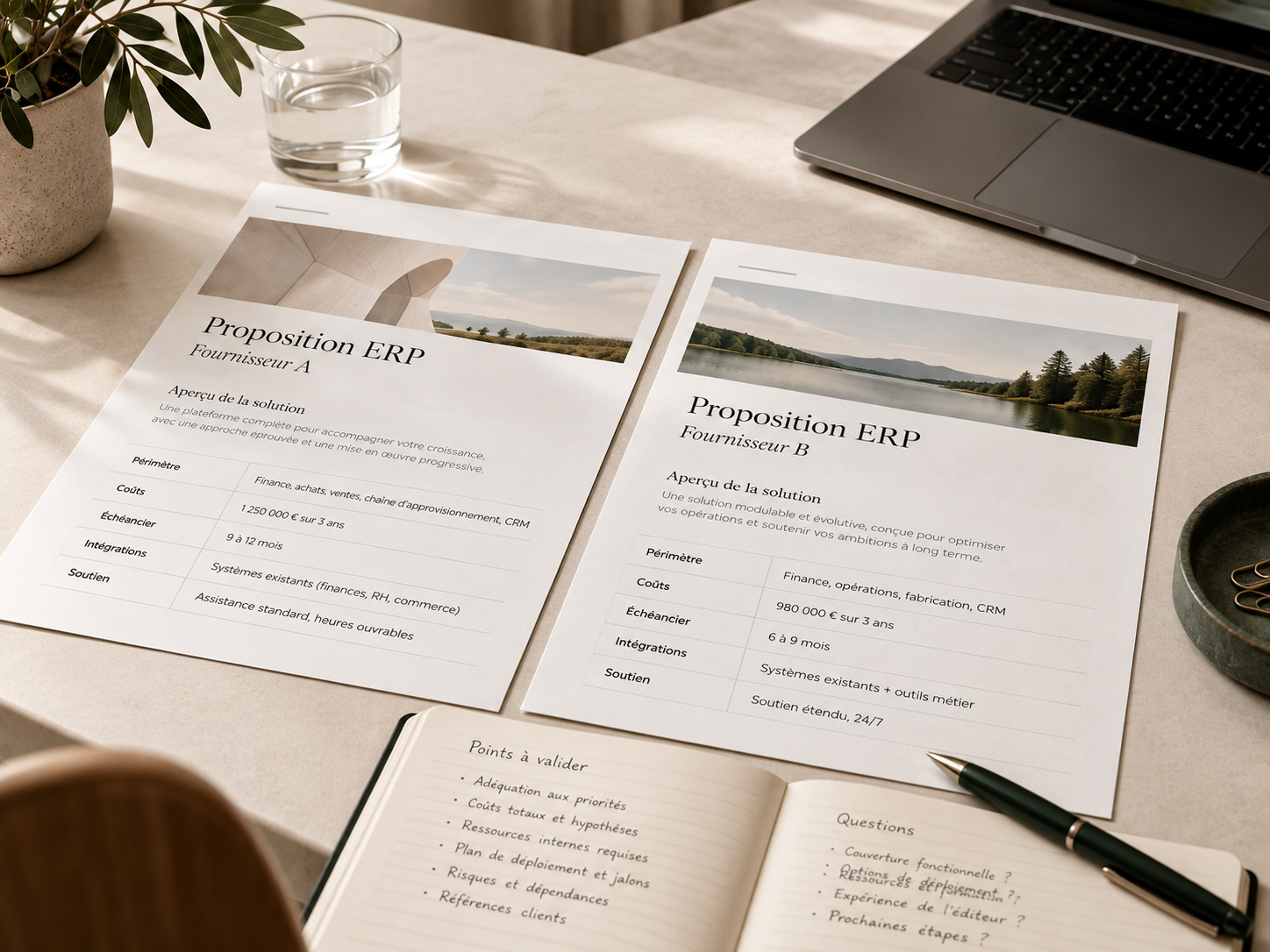
Compare the same scope and force every bidder to state assumptions and exclusions.
- Which modules, sites, entities and user groups are included?
- How many data conversions and test cycles are included?
- Which integrations are included, estimated or excluded?
- Who owns test scenarios and defect resolution?
- What training is included for each role?
- How much stabilization support is planned after launch?
- What conditions trigger a change request?
- Which recurring costs begin after year one?
A lower proposal may simply transfer more work to the client or postpone costs until after the contract is signed.
Why calculate ERP total cost of ownership over five years?
Because the initial implementation quote is only one part of the spend. Subscriptions, support, internal resources, integrations, complementary tools, training and post-launch improvements continue after go-live.
Build at least three scenarios: a credible minimum, a probable budget and a risk-adjusted case. If you are evaluating a specific platform, compare the same assumptions across every option. For Oracle specifically, see our Oracle Cloud ERP implementation cost guide.
How can you reduce cost without increasing project risk?
Reduce first-wave scope, stay close to standard processes and clean data early. Do not cut testing or stabilization just to protect a date.
- Phase the rollout instead of compressing testing.
- Adopt standard processes where they meet the business need.
- Clean and govern data before the first conversion cycle.
- Decide which integrations are genuinely required on day one.
- Name process owners who can make decisions quickly.
- Have the scope and commercial assumptions reviewed from the client side.
Frequently asked questions
How much does an ERP implementation cost for a mid-sized company in Quebec?
As a PlanAxion planning range, a limited single-entity cloud project may represent roughly CAD 150,000 to 400,000 in the first year. A multi-site or manufacturing organization often falls around CAD 400,000 to 1.5M, while a more complex transformation can exceed CAD 1.5M. A reliable estimate requires a defined scope.
Does the software price include implementation?
Usually not. Software subscriptions cover the right to use the platform. Design, configuration, data migration, integrations, testing, training, support and internal team effort must be budgeted separately.
How do you get a more reliable ERP budget?
Define processes, sites, entities, users by role, interfaces, data to migrate and compliance requirements first. Then ask each bidder to price the same scope and disclose assumptions and exclusions.
Should you choose the lowest ERP proposal?
Not on price alone. Compare functional fit, named delivery team, implementation method, five-year cost, contractual assumptions and the risks being transferred back to your organization.
- Oracle Fusion Cloud ERP: examples of enterprise ERP functional scope.
- Microsoft Dynamics 365 Supply Chain Management: examples of manufacturing, warehouse and supply-chain capabilities.
- Oracle NetSuite, ERP implementation phases: discovery, design, development, testing, deployment and support.