







Strategic enterprise AI workshop

Enterprise AI workshop to prioritize use cases

Identify the AI use cases worth funding, validate the required data, and leave with a roadmap ready to defend with leadership.
Groupe de travail participant à un atelier IA en entreprise
The workshop

Four weeks to go from vague ideas to a roadmap

The PlanAxion workshop is built for organizations under pressure to “do something with AI” without a clear plan. In four weeks, your team moves from scattered ideas to a portfolio of AI use cases evaluated and ranked against a shared framework, validated against your data, and ready to present to leadership.

The engagement runs over four weeks and includes two preparation days, two on-site workshop days, and an executive readout. One business unit at a time, with about five participants covering three roles: deciding, explaining the work, and validating the systems.

The deliverable

A roadmap your leadership can approve

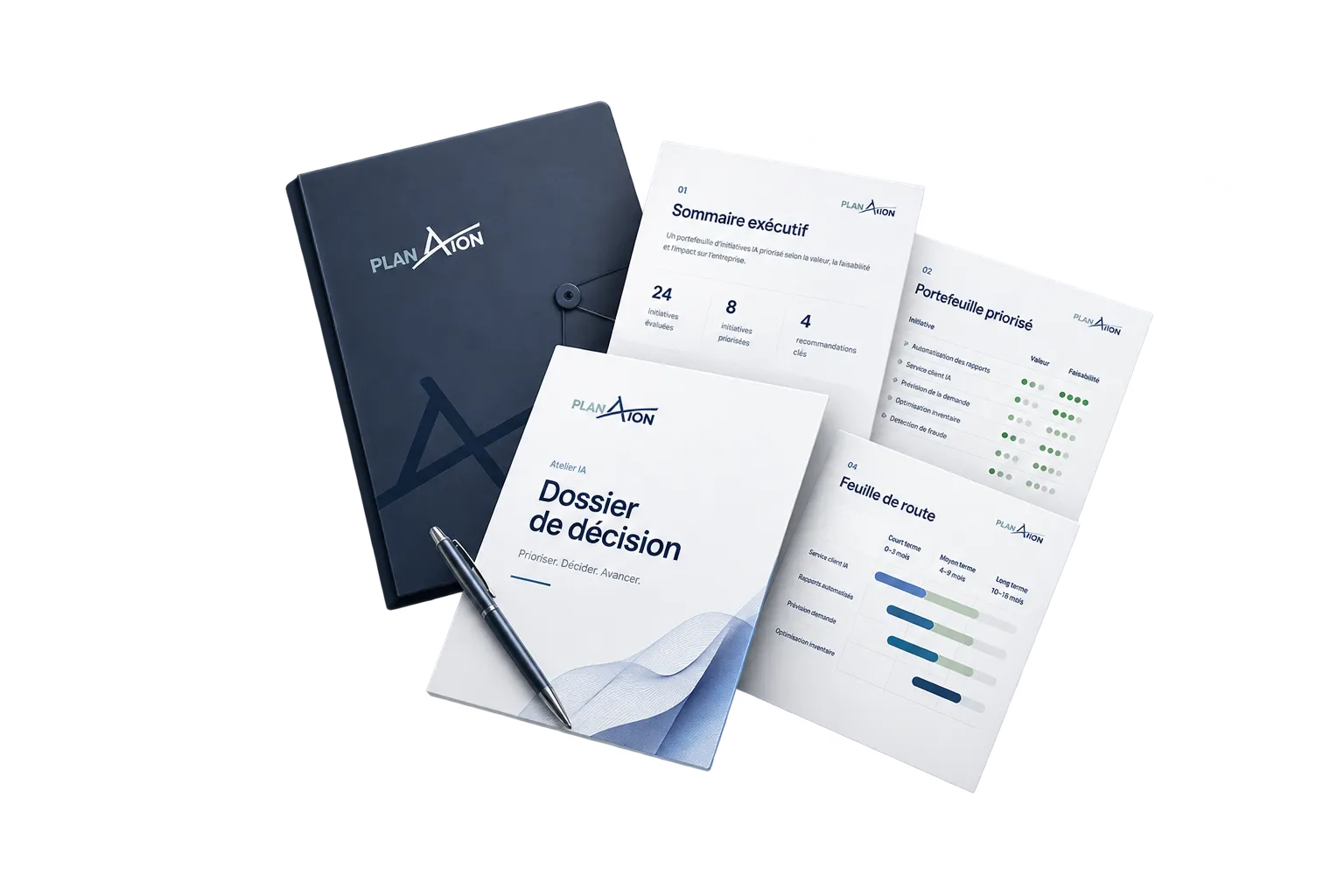
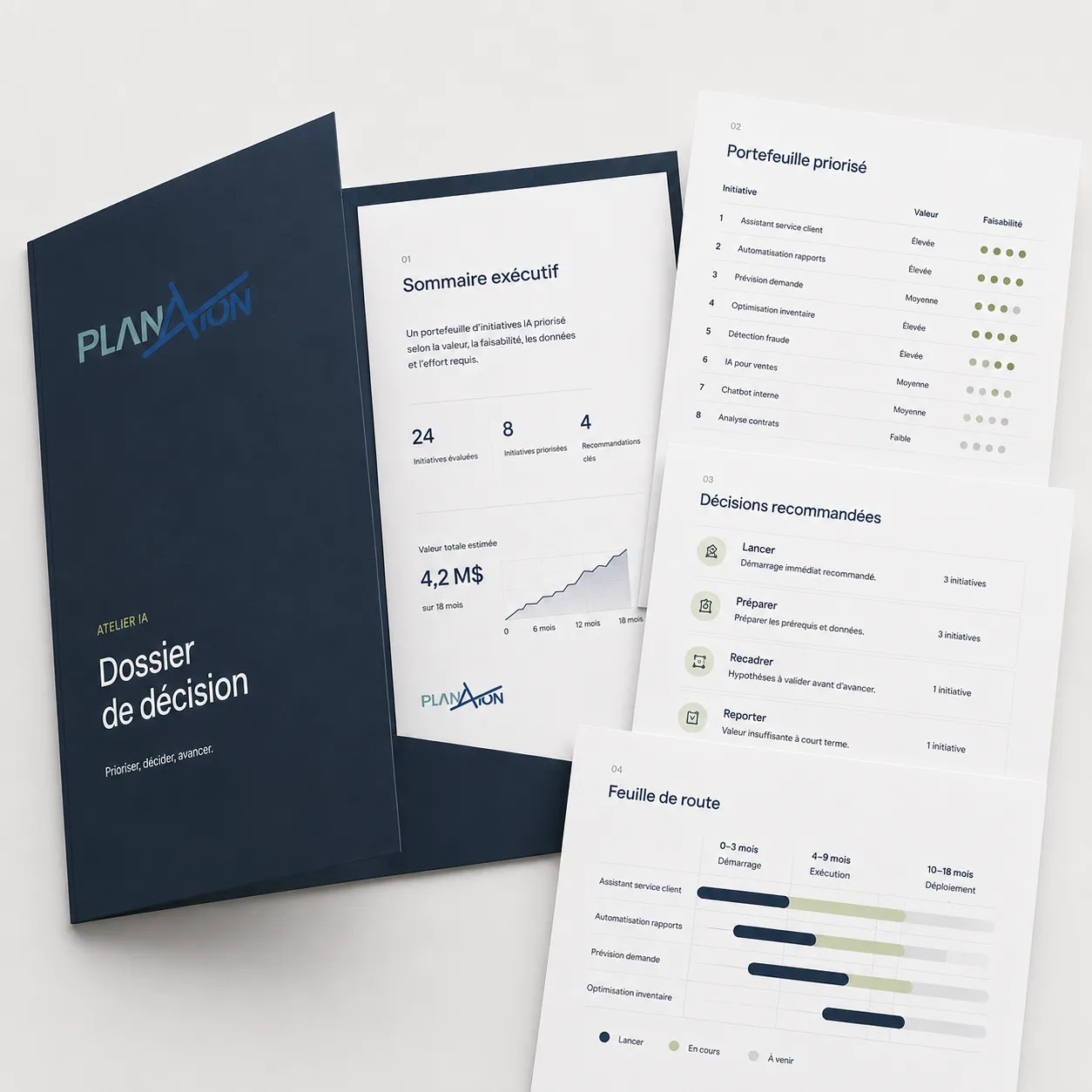
Executive summary ready for your leadership committee

Portfolio of AI use cases evaluated and ranked using a shared scorecard

Architecture and data considerations

Implementation plan executable by your teams, PlanAxion, or a partner of your choice

The investment depends on the scope, the teams involved, and the level of technical validation required. The budget is confirmed after a short scoping call.

Does the workshop depend on a specific tool or vendor?

The workshop remains independent of tools and vendors. Solutions are assessed after prioritization, based on existing systems, security requirements, and the level of integration required.

The process

Five steps across four weeks

01
Prepare

Pre-workshop questionnaire and an AI 101 refresher: everyone starts from the same point.

02
Identify

Ideation anchored in your operational friction, not in trends.

03
Prioritize

Every idea goes through the filter: problem, value, data, effort.

04
Validate the data

Diagnostic of the required data: available, reliable, usable or not.

05
Decide and deliver

A prioritized roadmap, presented and defended in front of leadership.

Why four weeks instead of a single day?

One day is enough to generate ideas. Four weeks allows time to prepare participants, verify data and systems, compare options, and deliver a recommendation leadership can actually evaluate.

The right filter

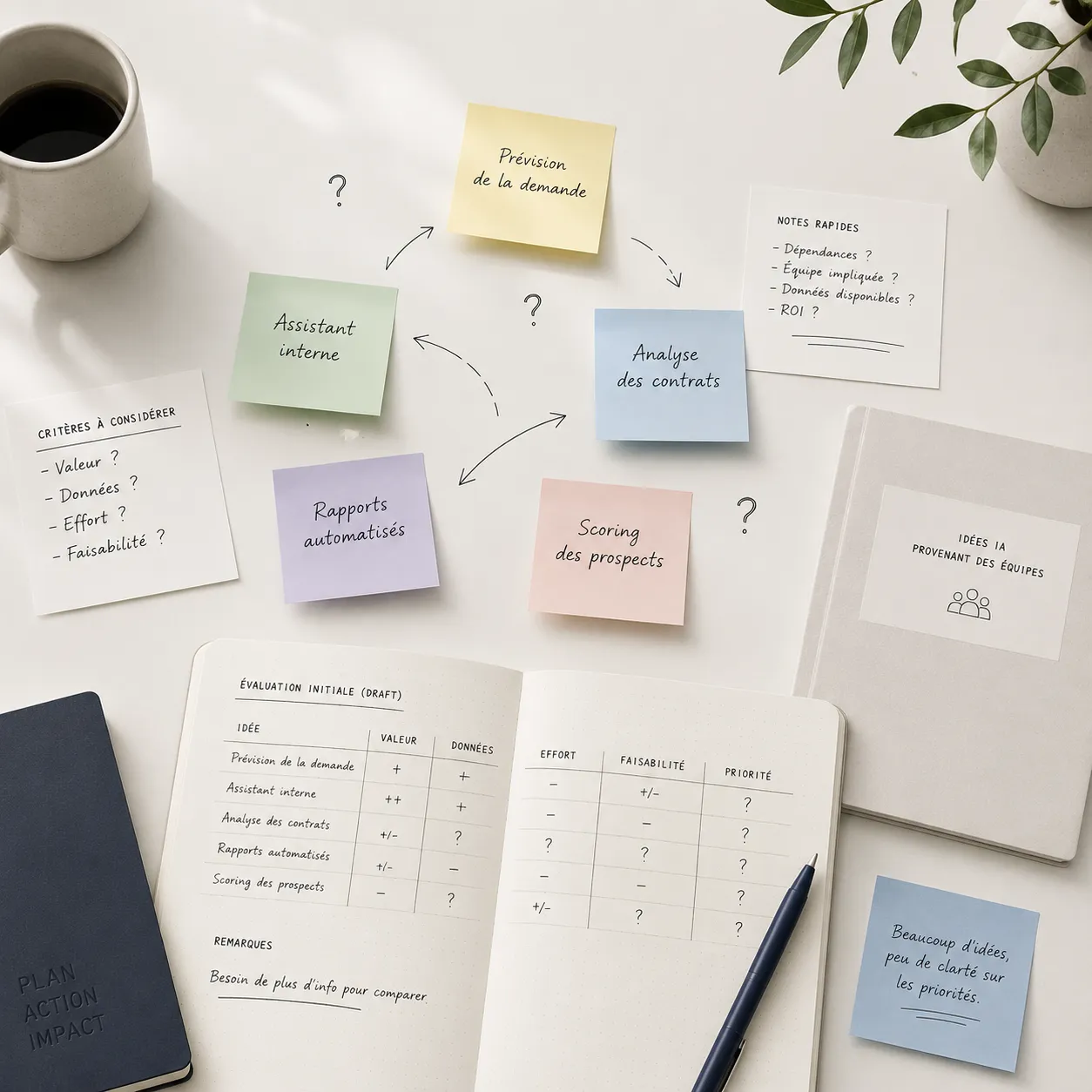
Four criteria settle every idea

Criterion 1
The problem to solve

Real, named, lived by a specific team. Not a hunch.

Criterion 2
The expected value

Measurable in time, quality or dollars. Otherwise, it waits.

Criterion 3
The data available

Existing, accessible and reliable enough to test without delay.

Criterion 4
The effort required

Proportionate to the gain. The first case should be testable in weeks.

The selected cases fall into quick wins, efficiency levers and strategic bets. The rest is deferred, not discarded.

Expected outcome

A sound decision may be not to launch

The workshop reduces uncertainty before an investment. Based on the facts gathered, the right conclusion may be to launch a pilot, prepare the data, narrow the use case, or defer an idea whose value has not yet been demonstrated.

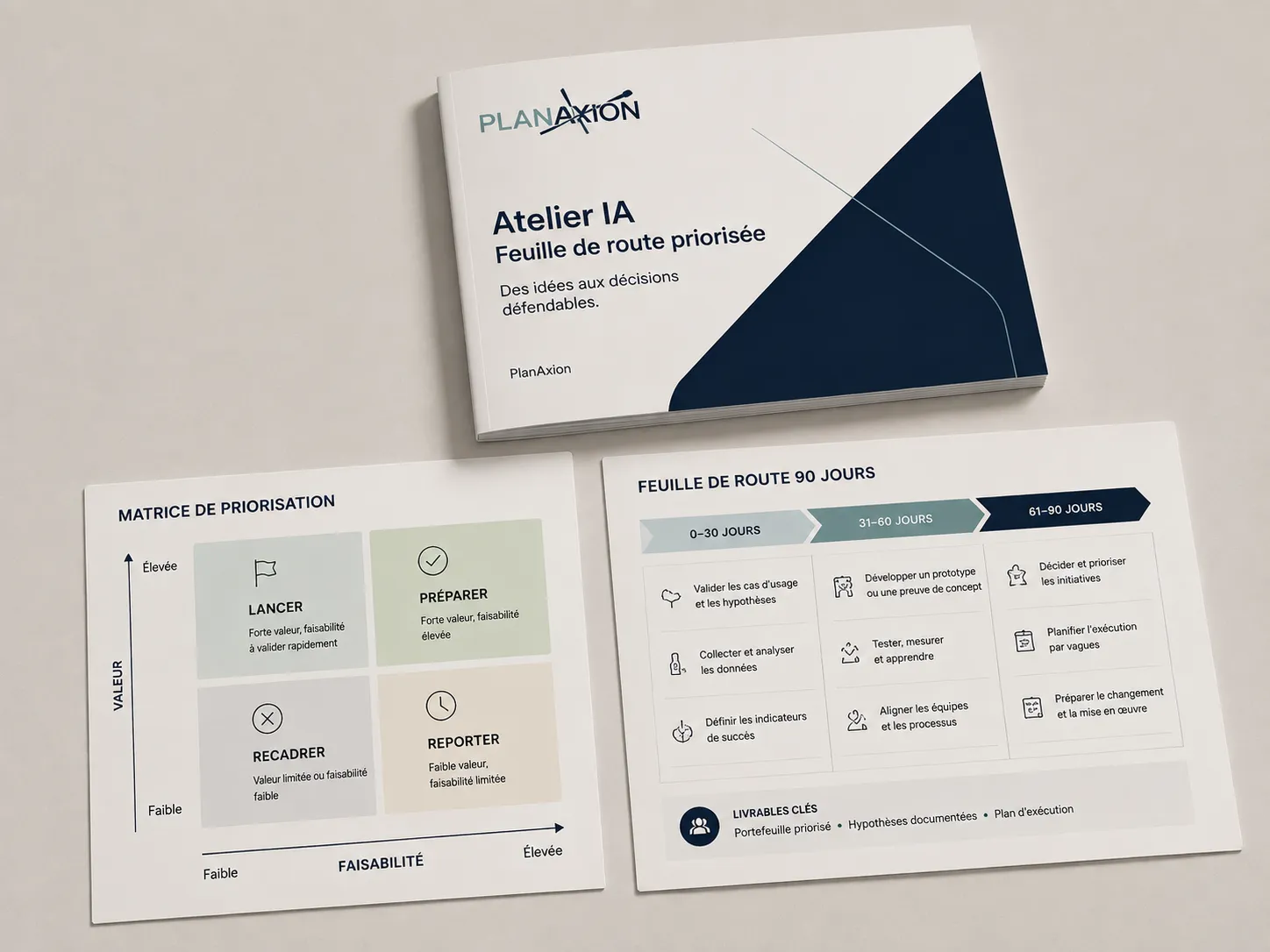
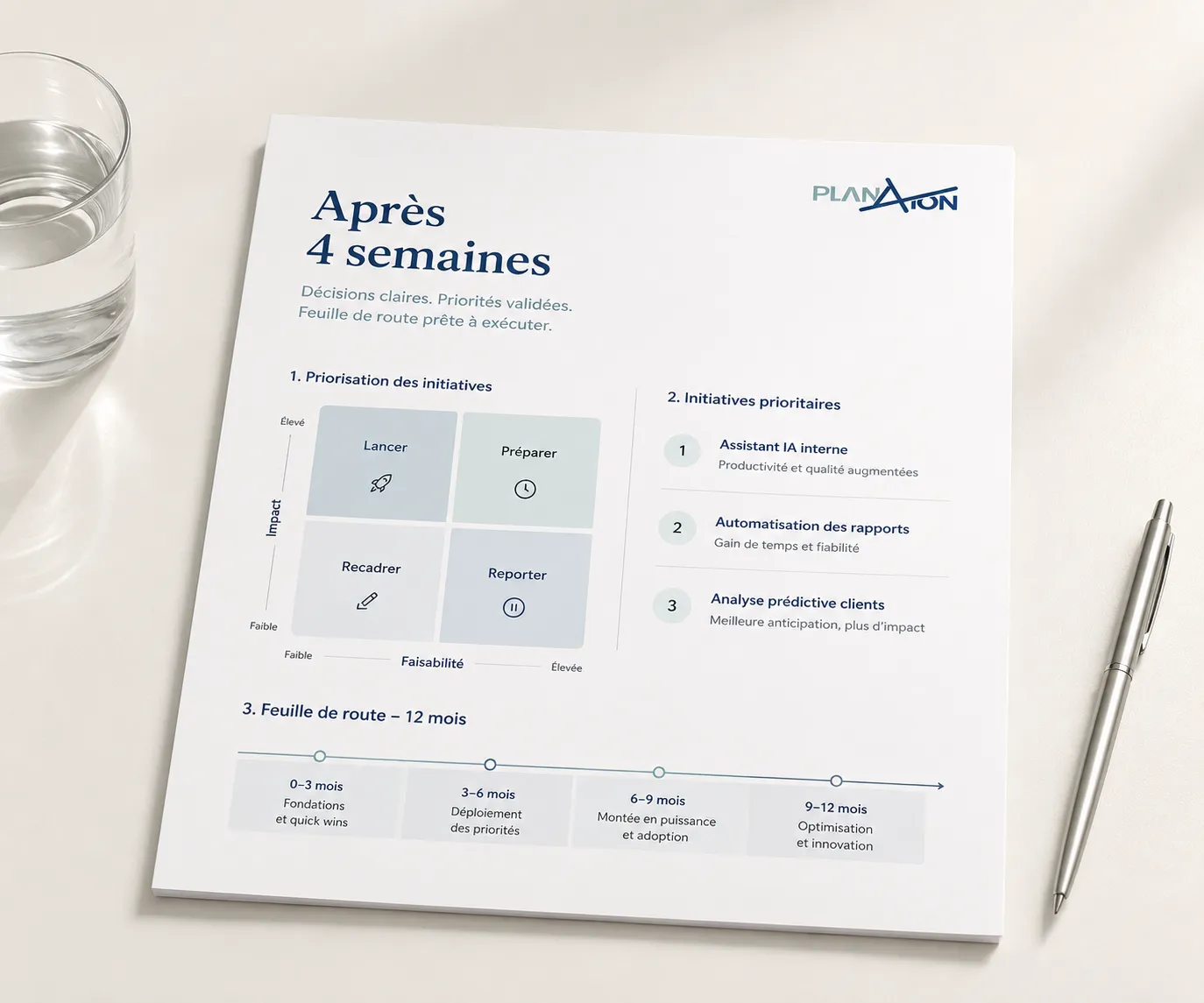
Launch

The problem, value, data and effort support a limited pilot.

Prepare

The value is clear, but a data or process dependency must be addressed.

Reframe

The idea is too broad. The use case, user and measure of success need to be defined.

Defer

The value or feasibility does not yet justify the investment.

Illustrative example

Three ideas. Three different decisions.

This fictional scenario shows how three ideas can lead to different decisions. The filter is not designed to make every idea win. It helps decide what to launch, prepare, or postpone.

Quick win

Route customer service emails

A precise problem, accessible data, and a measurable outcome. Decision: launch a limited pilot.

Prepare first

Forecast demand by product

High potential value, but an incomplete data history. Decision: improve the data before the pilot.

Reframe

Deploy an AI assistant everywhere

The problem is too vague and success cannot be measured. Decision: postpone it and define a specific use.

Fictional scenario created only to illustrate the method. It does not represent a client engagement or actual results.

Why PlanAxion

A workshop designed for decision-making, not just awareness

The credibility of the engagement comes from an explicit method and a combined business, data, architecture, security and adoption perspective: known criteria, documented assumptions, traceable decisions and deliverables your teams can use after the workshop.

01
Independent advice

Recommendations follow your business priorities, with no specific software to push or predetermined solutions.

02
Business and IT vision

Each idea is evaluated based on its value, available data, integration, security, and adoption.

03
Defensible decisions

The use cases are evaluated, ranked, and documented to support budget allocation decisions with leadership.

04
Moving to execution

PlanAxion can then oversee the pilot, architecture, and implementation of the selected use cases.

What the method makes verifiable

A problem and a measure of success

Each use case is tied to a specific operational issue, an owner and an observable outcome.

Assumptions separated from facts

Available data, unknowns and required validations are distinguished before any recommendation.

An explained decision

Each idea receives a clear decision: launch, prepare, reframe or defer, with the reasoning behind it.

An assignable next step

Dependencies, the owner, the next validation and the implementation order are documented in the roadmap.

The expertise brought into the workshop

The engagement combines several decision perspectives so each use case is operationally relevant and technologically realistic.

Processes and operations

Pain points, repetitive tasks, responsibilities, control points and expected gains.

Data and feasibility

Availability, quality, access, confidentiality and required human validation.

Architecture and integration

Compatibility with existing systems, information flows and technical dependencies.

Governance and adoption

Risks, usage rules, roles, security and implementation conditions.

AI use cases

How do you identify and prioritize AI use cases?

Identifying and prioritizing AI use cases means starting from the company's real operational friction, running every idea through a four-criteria filter (the problem to solve, the expected value, the data available, the effort required), then sorting the surviving cases into quick wins, efficiency levers and strategic bets. Ideas that fail the filter are deferred, not discarded.

At PlanAxion, this takes the form of a 4-week workshop in five steps: Prepare, Identify, Prioritize, Validate the data, Decide and deliver. About five participants are enough, provided three roles are covered: someone who can decide, someone who knows the floor, someone who can validate the systems. One business unit at a time, not the whole company.

The deliverable: a prioritized roadmap with an executive summary, a portfolio of AI use cases evaluated and ranked against a shared framework, and the data and architecture considerations required to move into execution.

What criteria should be used to prioritize an AI use case?

Four criteria settle it: is the problem real and named, is the expected value measurable, does the required data already exist, and is the effort proportionate to the gain. A use case strong on all four becomes a quick win. A case strong on value but weak on data becomes a strategic bet: prepare the data before launching.

How long does it take to build an AI roadmap?

Four weeks, when the exercise is properly framed. The first AI use case should be specific enough to test, measure and adopt. A useful roadmap gets built without launching a heavy transformation.

Who should be involved in identifying AI use cases?

About five people covering three roles: someone who can decide, someone who knows the day-to-day work and can explain it, someone who can validate the systems and the data. Without those three roles at the table, prioritization stays theoretical.

How much does a corporate AI workshop cost?

The budget depends on the scope, the teams involved, and the level of technical validation required. It is confirmed after a short scoping call once the business unit, participants, and data to examine are clearly defined.

What is the difference between an AI workshop and AI training?

AI training teaches you how to use tools. The PlanAxion workshop is a strategic mandate: it helps leadership, business teams, and IT managers decide where to invest, what to test, and what to postpone.

What deliverables do you receive at the end of the workshop?

You receive an executive summary, a portfolio of evaluated and ranked AI use cases, key data and architecture considerations, and a clear roadmap for the first initiatives.

What happens after the AI workshop?

Your organization can launch the selected quick wins with its own teams or ask PlanAxion to oversee the pilot, architecture, integration, and scaling.

When is the AI workshop not a good fit?

The workshop is less suitable for organizations seeking only tool training, those that have not yet selected a business unit to examine, or those unable to involve a decision-maker, a business lead, and someone who can validate the data. In those situations, an awareness session or a preliminary assessment is often a better first step.

Explore PlanAxion’s AI consulting and implementation services.

Scoping call

Let’s confirm whether the workshop fits your situation

This conversation helps clarify the objective, the business unit or process to examine, the people to involve, and the available data. If the workshop is not the right next step, we will say so clearly.

Duration

About 30 minutes

Participants

One person from leadership, operations or IT

To prepare

Your main objective, process or operational pain point

Next

A clear recommendation on the next step

No commitment is required. The goal is to confirm fit, not to force a workshop when the situation does not call for one.

Briefly describe your situation

These details will help prepare a useful conversation from the first call.

By submitting this form, you agree that PlanAxion may contact you about this request. Your information remains confidential.

Thank you. Your request has been received. A PlanAxion team member will contact you to validate the context and next step.

Thank you! Your submission has been received!
Oops! Something went wrong while submitting the form.