
Independent ERP comparison
For a Canadian business, both platforms cover enterprise needs, but they fit into different ecosystems. Architecture, processes, integrations, multi-entity requirements, and available talent must carry as much weight as the feature list.
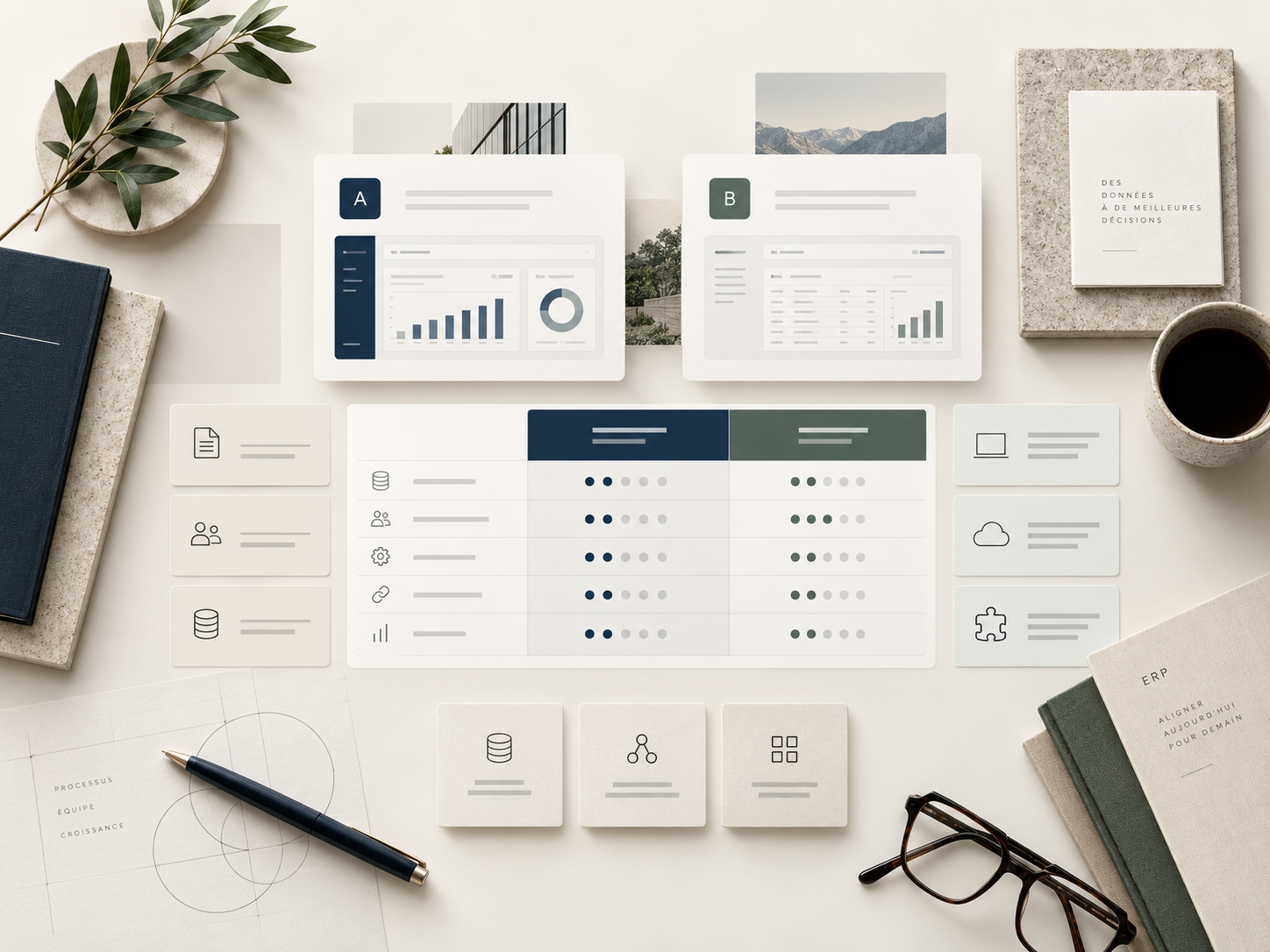
Dynamics 365 is particularly cohesive within a Microsoft environment. Oracle Fusion deserves serious consideration when an organization is looking for an extensive enterprise cloud suite or already has a strategic Oracle landscape. Compare the two using the same scenarios, data, integrations, and cost assumptions.
Process + architecture + talent + total cost + execution risk
Compare both platforms against the same decision criteria, not two different sales demos.
The comparison becomes much clearer when evaluating the existing ecosystem, operational depth, international requirements, and extension model rather than just feature lists.
This comparison turns existing editorial guidance into decision tests. The scenarios below are proposed for your demonstrations: they describe neither a client case nor an achieved result. Use the same scope and your representative data for both options.
Modularity and the cross-functional suite must serve the same target model.
Proposed scenario: Present finance, procurement, related functions and retained applications; request included and excluded applications.
Evidence to request: A scope and interface map for each proposal.
Financial coverage must be proven on the target group.
Proposed scenario: Simulate a multi-entity close with a correction and a control requirement.
Evidence to request: Report reconciliation, correction traces and gaps still open.
Operational integration is measured end to end.
Proposed scenario: Follow a procurement exception through inventory to its financial treatment.
Evidence to request: The scenario result and necessary Dynamics or Oracle applications.
Changing or retaining an ecosystem changes interface operations.
Proposed scenario: Request an exchange with retained CRM, WMS, payroll or banking systems, then diagnose an error.
Evidence to request: An interface contract, recovery procedure and required skills.
A low-code extension also needs maintenance ownership.
Proposed scenario: Submit a specific business rule and show how it will be approved, tested and maintained.
Evidence to request: The proposed solution, modification permissions and tests after changes.
International complexity can create gaps outside a standard demonstration.
Proposed scenario: Present a local need and a global report; request exact-offer coverage and remaining validations.
Evidence to request: A requirements matrix by entity, gaps and owners for confirmation.
Ecosystem alignment must offset transition costs and gaps.
Proposed scenario: Compare interface effort, covered exceptions and skill changes under both options.
Evidence to request: A weighted decision with demonstrated benefits and change risks.
Prefer Dynamics 365 if Microsoft is strategic and modularity, finance and operations cover scenarios with manageable extensions. Rule it out if critical international or operational requirements remain unproven or Microsoft alignment brings no concrete gain.
Prefer Oracle Fusion if a cross-functional integrated suite adds demonstrated value to the multi-entity structure and Oracle target. Rule it out if ecosystem change, interfaces or required extensions cancel that value; broad coverage on paper is insufficient.
Align actually included finance, operations and related functions before comparing proposals. Isolate CRM, WMS, payroll and banking interfaces, extensions, data and training, then ecosystem-change effort. Estimate international validation and team support capacity without assuming a familiar environment reduces every cost.
Request comparable proposals over the same horizon, separating initial costs, recurring costs and future changes. Make exclusions, assumptions and work remaining with the client explicit. No price, implementation timeline or cost ranking is asserted here.
The comparison can conceal different finance, procurement, HR or operational scopes. Confirm included Dynamics and Fusion applications, extension scope and local requirements. Microsoft alignment or an Oracle suite does not establish effortless integration or achieved compliance.
Source: existing editorial content of PlanAxion's “Dynamics 365 vs Oracle Fusion” page in the ERP Decision Pages CMS, including the short answer, criteria, table and FAQ. Editorial review of the source enrichment: October 6, 2026. Product guidance comes from the CMS, without new vendor verification. Tests, exclusion criteria and requested evidence are proposed evaluation methods, not verified capabilities. Confirm editions, versions, modules, deployment and local requirements in the documentation and proposal for your configuration before deciding.
This comparison helps define criteria, not pick a universal winner. Our independent ERP selection evaluates options against your processes, data, interfaces, and delivery constraints. Present your ERP context and the next decision to be made.
For each answer, request the exact scope, associated demonstration result, standard versus added functionality, and owner of any open issue. Record exclusions and evidence still needed before scoring both options.
The choice depends on critical processes, the technology ecosystem, integrations, multi-entity requirements, available skills, and total cost. Alignment with Microsoft or Oracle is a factor, but not sufficient proof on its own.
Often yes in terms of the ecosystem, but that is not enough if critical processes are not well covered.
Use the same scope, timeframe, and assumptions regarding data, integrations, and change management.
Use the same business rule, proposed solution, permissions, responsibility and change tests. The Microsoft flexibility and Oracle structure discussed in the CMS are insufficient to decide without the exact offer and skills.
A local need combined with a group report, with explicit coverage by each application and gaps still to confirm. Global positioning does not guarantee every local requirement.
Weigh better-covered exceptions against interfaces to rebuild, skills to acquire and data to transform. Require target-system evidence and comparable estimates, not a presumed brand advantage.
PlanAxion compares platforms based on your processes, integrations, data, internal capabilities, and transformation constraints.
Comparing Dynamics and Oracle