
Independent ERP comparison
Both platforms can serve manufacturers and distributors. The decision must weigh industry depth, architecture, ecosystem, available talent, and total cost.
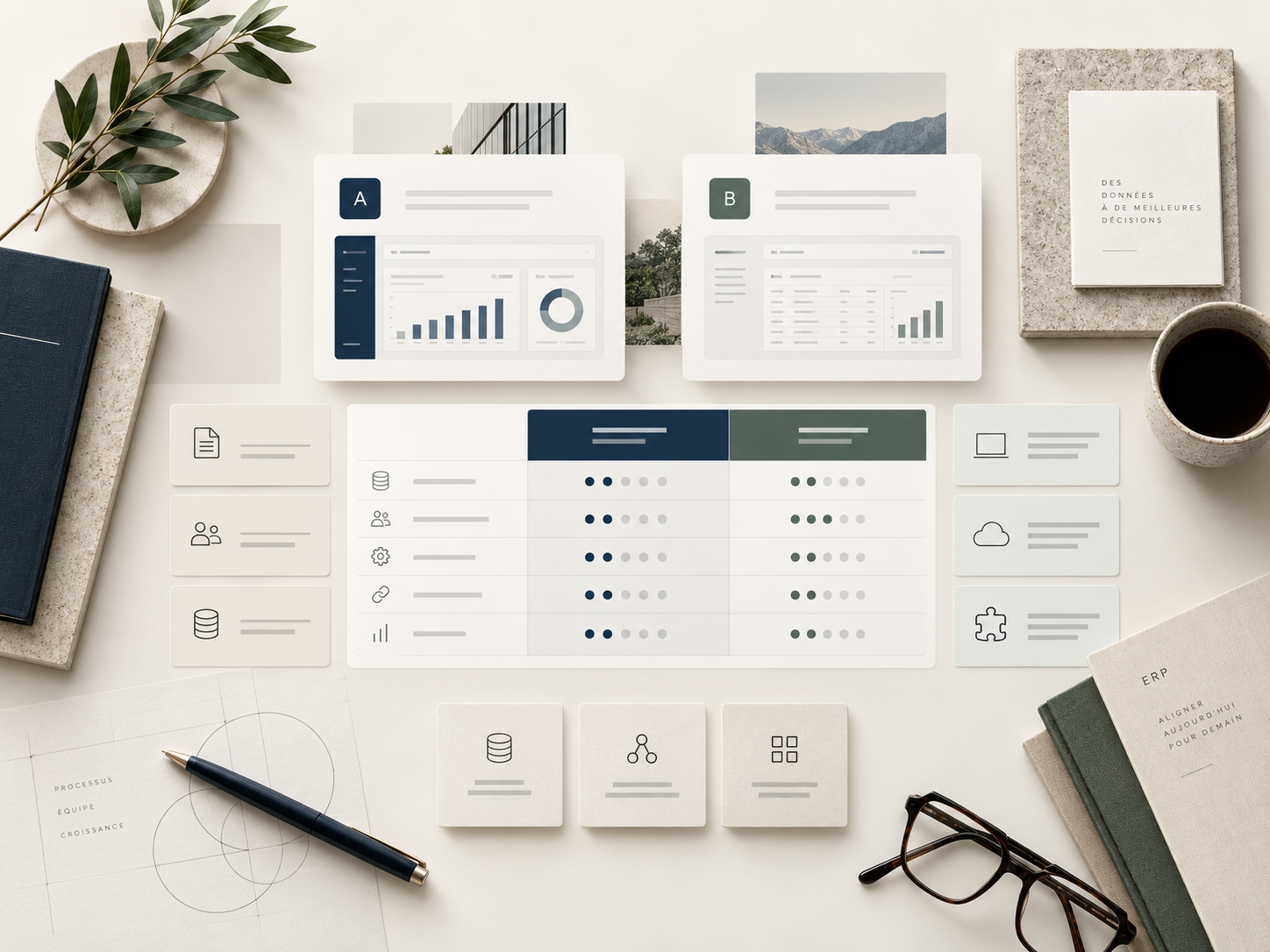
Infor can be particularly relevant when its industry-specific solutions align closely with your operations. Dynamics 365 often becomes the natural choice for an organization already heavily standardized on Microsoft.
Process + architecture + talent + total cost + execution risk
Compare both platforms against the same decision criteria, not two different sales demos.
The best choice depends primarily on the level of industry depth required, the existing ecosystem, and the availability of skills to govern and operate the solution.
This comparison turns existing editorial guidance into decision tests. The scenarios below are proposed for your demonstrations: they describe neither a client case nor an achieved result. Use the same scope and your representative data for both options.
An industry orientation is useful only for the selected product.
Proposed scenario: Present your industry and a critical process; name the evaluated Infor product and Dynamics applications.
Evidence to request: Exact scope and mapping of needs to proposed offers.
Industry depth must reduce gaps, not merely expand the catalogue.
Proposed scenario: Submit an industry exception and request a response without hiding manual interventions.
Evidence to request: The scenario result and classification as standard, configuration, extension or workaround.
Manufacturing-distribution coverage depends on the flow actually traversed.
Proposed scenario: Follow a production or inventory change through procurement and finance.
Evidence to request: Flow traceability and required applications or specific capabilities.
Ecosystem alignment must simplify a concrete exchange.
Proposed scenario: Produce a metric and exchange data with a retained application.
Evidence to request: Interface architecture, metric origin and recovery responsibilities.
Extensions depend on the exact product and architecture.
Proposed scenario: Add a specific rule and explain how it will be maintained during a change.
Evidence to request: An extension register, dependencies and proposed regression tests.
A large technology talent pool does not guarantee senior ERP expertise.
Proposed scenario: Have the team actually assigned to the project and support explain a business exception and an incident.
Evidence to request: Specifically proposed roles, ERP skills, backup coverage and named responsibilities.
Specialization must be weighed against long-term cross-functional value.
Proposed scenario: Weight industry gaps, Microsoft interfaces and partner dependency.
Evidence to request: A reasoned decision including skill risks and maintenance effort.
Prefer Infor if the exact industry product covers critical processes with fewer gaps and customizations. Rule it out if coverage is proven only at brand level, or necessary architecture dependencies and specialized skills cannot be sustained.
Prefer Dynamics 365 if cross-functional coverage and Microsoft alignment create demonstrated value while covering industry exceptions. Rule it out if Microsoft familiarity conceals important business gaps or available technology talent lacks the required ERP expertise.
Require the Infor product and version, then selected Dynamics applications, for the same industry scope. Estimate gaps to standard, interfaces, data, business testing and training. Compare maintenance workload and specialized-skill coverage with governance of Microsoft extensions; neither network breadth nor industry depth constitutes a price.
Request comparable proposals over the same horizon, separating initial costs, recurring costs and future changes. Make exclusions, assumptions and work remaining with the client explicit. No price, implementation timeline or cost ranking is asserted here.
Infor and Dynamics are families: generalizing a capability from the brand name distorts the comparison. Infor skills may depend on market and product, while the Microsoft pool does not guarantee senior ERP expertise. Confirm the version, target architecture and support backup before deciding.
Source: existing editorial content of PlanAxion's “Infor vs Dynamics 365” page in the ERP Decision Pages CMS, including the short answer, criteria, table and FAQ. Editorial review of the source enrichment: October 6, 2026. Product guidance comes from the CMS, without new vendor verification. Tests, exclusion criteria and requested evidence are proposed evaluation methods, not verified capabilities. Confirm editions, versions, modules, deployment and local requirements in the documentation and proposal for your configuration before deciding.
This comparison helps define criteria, not pick a universal winner. Our independent ERP selection evaluates options against your processes, data, interfaces, and delivery constraints. Present your ERP context and the next decision to be made.
For each answer, request the exact scope, associated demonstration result, standard versus added functionality, and owner of any open issue. Record exclusions and evidence still needed before scoring both options.
Infor offers highly industry-specific solutions, but their relevance must be verified against your processes and target version.
This can create an ecosystem advantage, but ERP process coverage remains the primary criterion.
Because the CMS states that industry coverage, extensions and architecture depend on the selected product. Require product, version and scope, then compare the same exceptions with the proposed Dynamics applications.
Replay an industry exception and classify every response as standard, configuration, extension or workaround. Compare the resulting register and its upkeep; an industry catalogue is insufficient.
Evaluate the actual proposed ERP team, its explanation of the exception, backup coverage and support. Do not confuse technology ecosystem size with experts available for your product and industry.
PlanAxion helps test Infor and Dynamics 365 against your critical workflows, integrations, and your ability to operate the solution post-project.
Comparing Infor and Dynamics