
{ "@context": "https://schema.org", "@type": "WebPage", "@id": "https://www.planaxion.com/en-ca/erp-decisions/manufacturing-erp-budget#webpage", "name": "Manufacturing ERP budget", "url": "https://www.planaxion.com/en-ca/erp-decisions/manufacturing-erp-budget", "inLanguage": "en-CA", "publisher": { "@type": "Organization", "@id": "https://www.planaxion.com/#organization", "name": "PlanAxion", "url": "https://www.planaxion.com/" } }

ERP Decision Guide

What budget should you plan for a manufacturing ERP?

The budget is built around actual operations: planning, production, quality, inventory, maintenance, technical data, factory interfaces, and the number of sites.
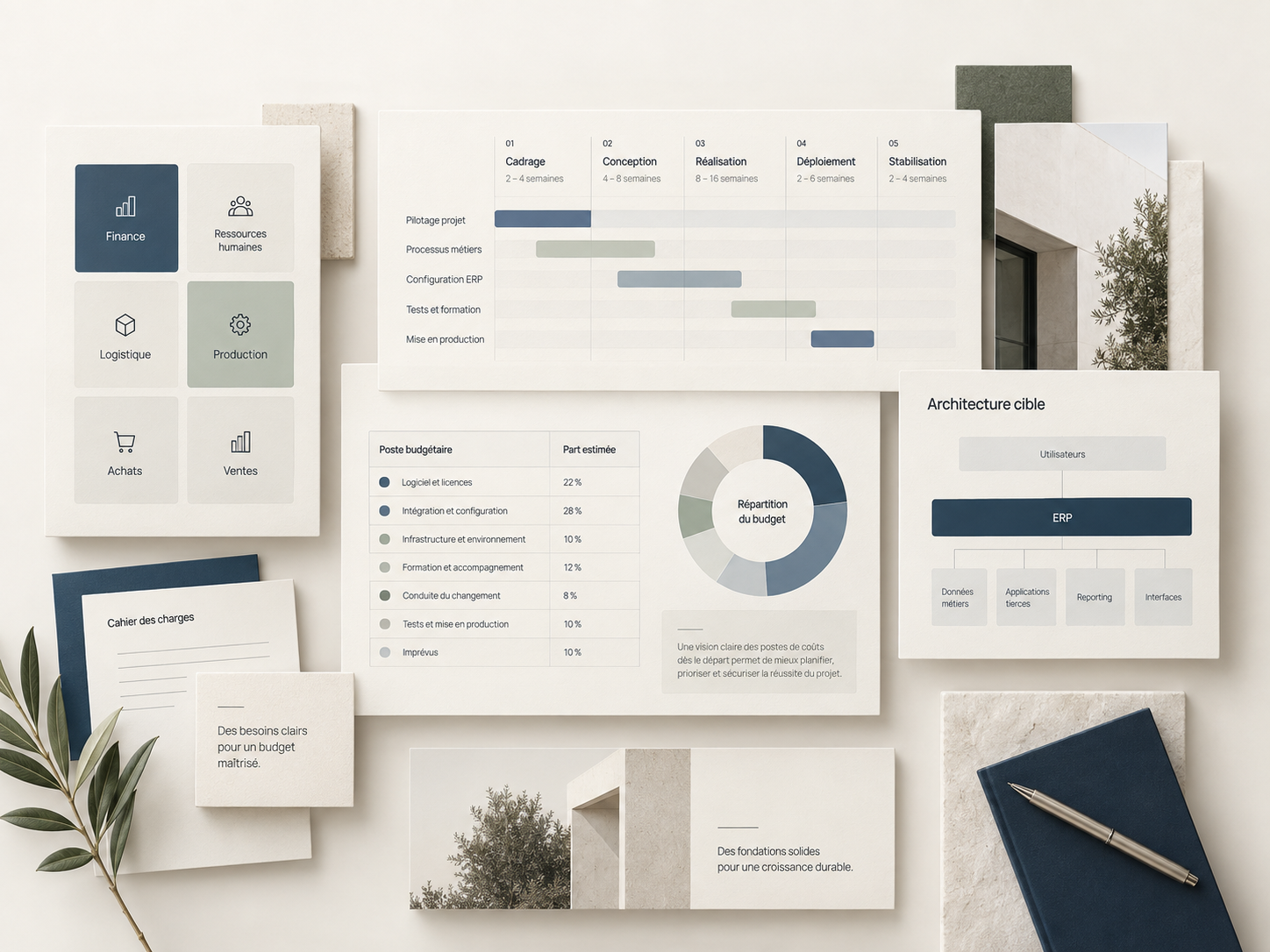
Editorial composition illustrating ERP project planning with modules, timeline, budget items, and target architecture.

The budget is determined as much on the shop floor as it is in finance.

Costs increase when the scope includes production, MES, equipment, traceability, item data, and multi-site scenarios.

ERP + shop floor + data + integrations + field testing + adoption

  • Production increases the number of scenarios to test.
  • Technical data must be ready before serious testing begins.
  • Multi-site operations increase the need for standardization trade-offs.

Budget items for the plant, not just for finance

  1. ERP core. Finance, purchasing, sales, inventory, and master data form the foundation, but they aren't enough to cost out a manufacturing environment.
  2. Planning and production. MRP, scheduling, bills of materials, routings, subcontracting, and capacity add business scenarios that need to be designed and tested.
  3. Shop floor, quality, and equipment. MES, data collection, traceability, quality, maintenance, and machine interfaces can represent a distinct scope.
  4. Technical data. Items, bills of materials, routings, units, and history must be cleaned up before serious testing begins.
  5. Field testing and cutover. Scenarios must be validated with users and real production constraints, not just in a conference room.
  6. Multi-site deployment and adoption. Each plant adds variations, super-users, training, and decisions about what will be standardized.

The variables that most impact the manufacturing budget

  • Process variability. The more differently plants operate, the heavier the design and testing requirements become.
  • Level of automation. MES, equipment, labeling, scanners, and shop floor interfaces shift costs toward integration.
  • Data quality. Poorly governed technical data quickly brings testing to a halt.
  • Production constraints. Short cutover windows and the need for continuous operations increase the preparation required.
  • Quality requirements. Traceability, batches, serialization, and regulated controls add layers of evidence and validation.

Request a budget by critical operational scenario. This quickly reveals items that were oversimplified or overlooked in a global estimate.

To translate these cost factors into a scope and business case tailored to your organization, our independent ERP scoping clarifies the assumptions that need to be validated before comparing proposals. Share your ERP context and the next decision you need to make.

The questions that reveal the true manufacturing effort.

  1. Which processes must be standardized across plants?
  2. Which shop floor interfaces are mandatory for day one?
  3. Who owns the quality of the bills of materials and routings?
  4. Which scenarios must be tested under real-world conditions?
  5. What super-user capacity is available per site?

Frequently asked questions

Why does a manufacturing ERP cost more than a financial ERP?

Because it involves more physical processes, technical data, integrations, and operational scenarios.

Should the MES be included in the same budget?

At a minimum, you must budget for integration and design impacts, even if the MES remains a separate project.

Turn real-world operations into a defensible budget.

PlanAxion connects production processes, data, integrations, and scope to avoid a manufacturing ERP budget built solely on licensing.

Frame my manufacturing budget