
ERP Decision Guide
Both may appear on the same shortlist, but they don't win for the same reasons. You need to compare multi-entity capabilities, growth models, industry focus, partner ecosystems, and the effort required for extensions.
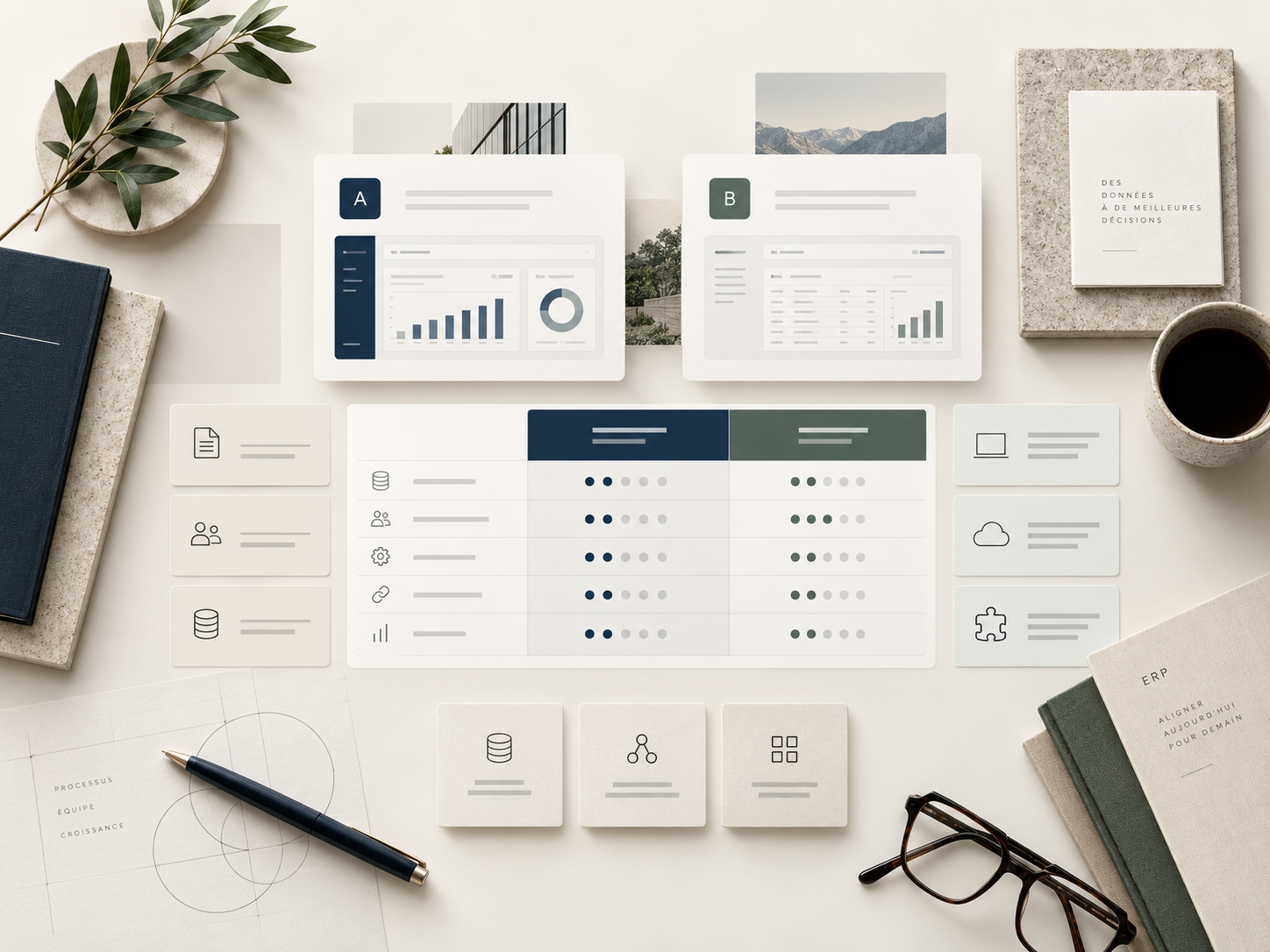
NetSuite focuses on an integrated cloud suite with a strong presence among growing, multi-entity organizations. Acumatica targets mid-sized businesses with industry-specific editions, including manufacturing, distribution, construction, and retail.
Process + architecture + data + integrations + risk
Compare both platforms against the same decision criteria, not two different sales demos.
There is no universal winner: the weighting must reflect your processes, your architecture, and your execution capacity.
This comparison turns existing editorial guidance into decision tests. The scenarios below are proposed for your demonstrations: they describe neither a client case nor an achieved result. Use the same scope and your representative data for both options.
Global growth and industry specialization do not necessarily address the same need.
Proposed scenario: Present a mid-sized business deciding between adding entities and deepening its industry process.
Evidence to request: A target-scope map showing shared functions and industry-specific requirements.
The group structure can matter more than local coverage.
Proposed scenario: Simulate an intercompany transaction, then the consolidated close with a late correction.
Evidence to request: Accounting reconciliation, consolidation steps and adjustments remaining with the client.
An edition's name does not demonstrate operational fit.
Proposed scenario: Choose your critical manufacturing, distribution, construction, services or retail flow and add a representative exception.
Evidence to request: Execution in the proposed edition, identifying included functions and add-ons.
The network is useful only if the partner can cover your context.
Proposed scenario: Ask the partner to replay the industry flow and explain who will handle an incident after go-live.
Evidence to request: Proposed team, support responsibilities and test result, rather than a partner logo alone.
Flexibility can complicate maintenance of interfaces and add-ons.
Proposed scenario: Add a need missing from the standard, then simulate a change in exchanged data.
Evidence to request: A SuiteApp or customization register, interface contracts and recovery tests.
Global scope and customization create different implementation effort.
Proposed scenario: Request a work breakdown for the same entities, industry and data to migrate.
Evidence to request: Work packages separating consolidation, industry configuration, data, testing and client work.
The suite and edition must be weighed using common evidence.
Proposed scenario: Compare close and industry-flow results, then weight gaps and add-on effort.
Evidence to request: A decision scorecard explaining whether global structure or operational fit dominates.
Prefer NetSuite if the integrated suite and multi-entity growth address demonstrated scenarios. Rule it out if a decisive industry process needs SuiteApps and workarounds that make the architecture too difficult to support; a broader suite does not prove better fit.
Prefer Acumatica if the proposed industry edition demonstrably reduces operational gaps and the partner can show them. Rule it out if target consolidation or required customizations remain insufficiently proven; a dedicated edition does not guarantee every complex case.
Isolate SuiteApps and global scope for NetSuite, and industry edition, customization and integrations for Acumatica. Compare the same close, entities and industry flow. Include partner qualification, business-data migration, add-on testing and internal support workload.
Request comparable proposals over the same horizon, separating initial costs, recurring costs and future changes. Make exclusions, assumptions and work remaining with the client explicit. No price, implementation timeline or cost ranking is asserted here.
The trade-off can be distorted by a suite demonstration without exceptions or a reassuring industry-edition name. Validate the Acumatica version and edition, NetSuite add-ons and partner responsibilities; document consolidation gaps rather than inferring a universal superiority.
Source: existing editorial content of PlanAxion's “NetSuite vs Acumatica” page in the ERP Decision Pages CMS, including the short answer, criteria, table and FAQ. Editorial review of the source enrichment: October 6, 2026. Product guidance comes from the CMS, without new vendor verification. Tests, exclusion criteria and requested evidence are proposed evaluation methods, not verified capabilities. Confirm editions, versions, modules, deployment and local requirements in the documentation and proposal for your configuration before deciding.
Two organizations can make different choices with the exact same products. Partner quality, available skills, industry depth and the total cost of the architecture matter just as much as the feature list.
This comparison helps define the criteria, not pick a universal winner. Our independent ERP selection evaluates options against your processes, data, interfaces and delivery constraints. Share your ERP context and the next decision you need to make.
For each answer, request the exact scope, associated demonstration result, standard versus added functionality, and owner of any open issue. Record exclusions and evidence still needed before scoring both options.
No. It targets mid-sized businesses and various sectors, but the required complexity must be validated.
The answer depends on the scenario. A broader suite on paper is not automatically a better fit.
Replay a complete industry flow with an exception chosen by your team. Record what belongs to the edition, an add-on or manual intervention; the advantage is demonstrated gap reduction, not the industry label.
When the integrated suite and multi-entity structure create demonstrated value in the close and group flows. That priority must still withstand industry tests and the list of required SuiteApps.
Evaluate its team, demonstration of the selected flow, data plan and support model. Compare that evidence separately from product positioning; no client case is invented here.
PlanAxion structures the criteria, demonstrations, and client-side proof to compare options on a consistent basis.
Structure my ERP decision