
Independent ERP comparison
Two robust enterprise suites with different philosophies and ecosystems. Your decision should be based on your processes, your architecture, and the level of transformation you are prepared to undertake.
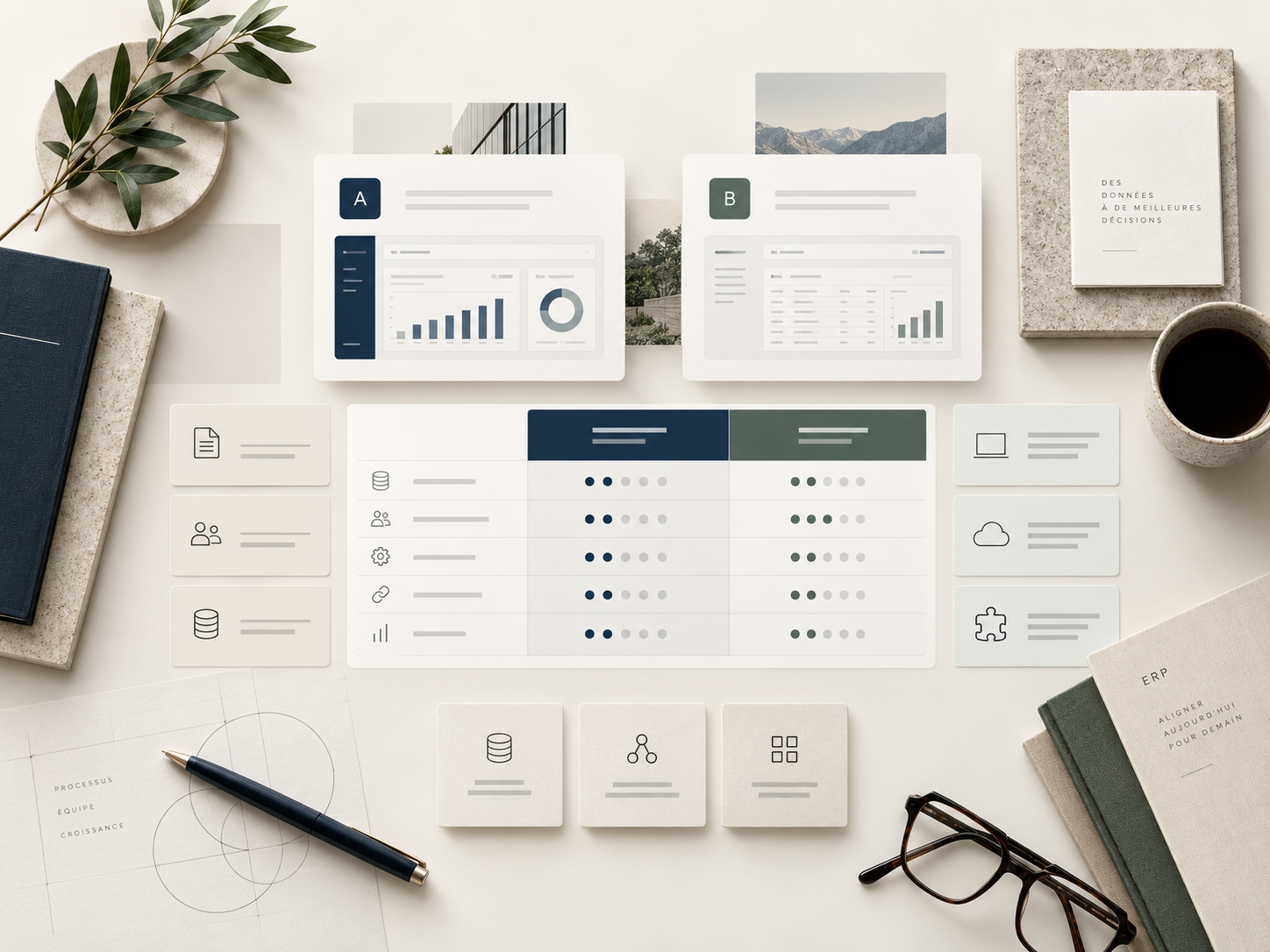
SAP is frequently evaluated for industrial, complex, and highly integrated environments. Oracle Fusion is often attractive for a broad cloud ERP strategy, especially when the Oracle ecosystem is already significant.
Process + architecture + talent + total cost + execution risk
Compare both platforms against the same decision criteria, not two different sales demos.
Both platforms can support a large enterprise. The real difference emerges in the target operating model, cloud architecture, existing skills, and operational complexity.
This comparison turns existing editorial guidance into decision tests. The scenarios below are proposed for your demonstrations: they describe neither a client case nor an achieved result. Use the same scope and your representative data for both options.
The existing landscape can be an asset or a constraint.
Proposed scenario: Present the core industrial process and functions to combine in the target; distinguish what must stay from what must change.
Evidence to request: A justified target map and identified legacy dependencies.
Finance depth must be tested against actual international requirements.
Proposed scenario: Simulate a group close with a correction and a local control need to validate.
Evidence to request: Reconciled reports, observed controls and local requirements still open.
Operational exceptions reveal more than the standard flow.
Proposed scenario: Submit an industrial exception that crosses procurement, operations and finance.
Evidence to request: The end-to-end result, workarounds and functions used from the exact offer.
Moving to cloud must clarify the standard and existing dependencies.
Proposed scenario: Explain how to retain or replace a legacy interface and handle a target-system change.
Evidence to request: Deployment architecture, a standardization plan and proposed compatibility tests.
Integrated data must remain explainable to teams.
Proposed scenario: Reconstruct a group metric from transactions and a data correction.
Evidence to request: Metric traceability, transformation rules and quality responsibilities.
Migration should not reproduce existing problems without examination.
Proposed scenario: Submit historical data and a legacy rule; identify what migrates, is archived or changes.
Evidence to request: A migration plan, expected reconciliations and transformation decisions.
The choice depends on the value of the existing estate as well as the cloud model.
Proposed scenario: Compare industrial gaps and expected Oracle simplification gains with available skills.
Evidence to request: A decision scorecard linking tests, dependencies, effort and responsibilities.
Prefer SAP S/4HANA if industrial operations or the SAP estate remain decisive and tests justify placing them at the target's core. Rule it out if retaining that landscape mainly preserves dependencies and gaps you want to eliminate, without demonstrated value.
Prefer Oracle Fusion if the integrated cloud suite and Oracle ecosystem genuinely simplify target functions and architecture. Rule it out if industrial exceptions are not covered in the selected offer or the organization seeks to recreate its former model without accepting required transformation.
Isolate migration of the SAP estate, interface replacement and data harmonization, then the proposed SAP or Fusion application scope. Estimate standardization, edge-process testing and training in the target model. Compare teams' effort to decide which historical data and rules to retain, not cloud infrastructure cost alone.
Request comparable proposals over the same horizon, separating initial costs, recurring costs and future changes. Make exclusions, assumptions and work remaining with the client explicit. No price, implementation timeline or cost ranking is asserted here.
Transition from the existing system is a major risk: retaining it without justification or reproducing it unchanged can compromise the target. Confirm SAP editions and deployments and included Fusion applications. SaaS does not eliminate transformation, data and integration work.
Source: existing editorial content of PlanAxion's “SAP S/4HANA vs Oracle Fusion” page in the ERP Decision Pages CMS, including the short answer, criteria, table and FAQ. Editorial review of the source enrichment: October 6, 2026. Product guidance comes from the CMS, without new vendor verification. Tests, exclusion criteria and requested evidence are proposed evaluation methods, not verified capabilities. Confirm editions, versions, modules, deployment and local requirements in the documentation and proposal for your configuration before deciding.
This comparison helps define criteria, not pick a universal winner. Our independent ERP selection evaluates options against your processes, data, interfaces, and delivery constraints. Present your ERP context and the next decision to be made.
For each answer, request the exact scope, associated demonstration result, standard versus added functionality, and owner of any open issue. Record exclusions and evidence still needed before scoring both options.
Yes. The difference should be based on your process coverage, architecture, talent, and execution capacity.
The SaaS model simplifies certain infrastructure aspects, but the transformation of processes, data, and integrations remains an enterprise-wide program.
For each rule, interface and historical dataset, request its business value, role in the industrial process and maintenance cost. Validate what migrates, is archived or is transformed; the existing estate is not automatically an advantage.
Use a cross-functional activity and an industrial exception, comparing interfaces, re-entry and controls in the current and proposed target systems. Treat the integrated suite as an advantage only if the gaps demonstrably decrease.
A migration plan with data scope, transformation rules, expected reconciliations and owners. Tests remain to be executed; no client migration schedule or result is announced here.
PlanAxion structures the criteria of scope, architecture, operations, data, and execution to make both scenarios comparable from the client's perspective.
Comparing SAP and Oracle