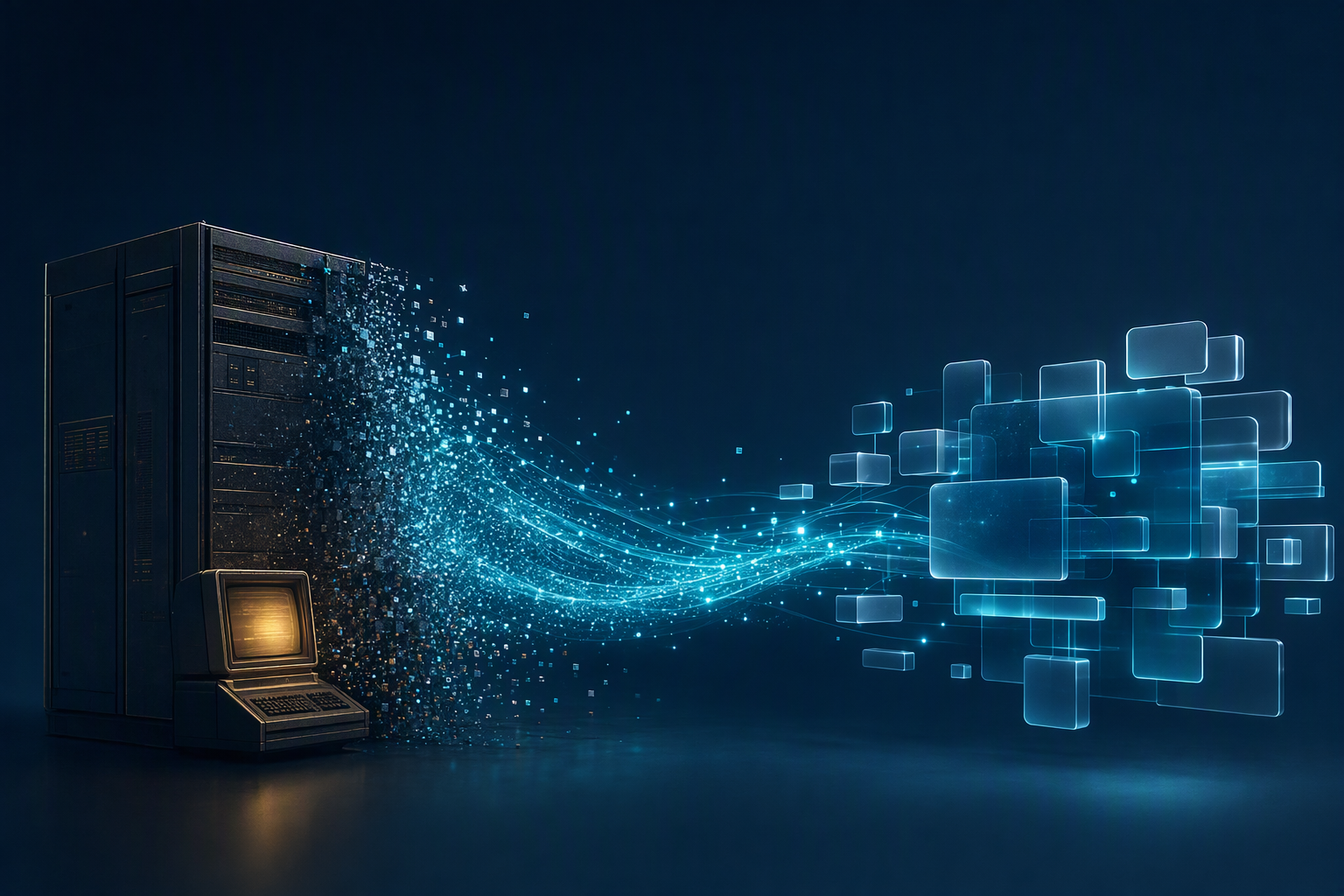
- The risk goes beyond the age of the code. When a platform is no longer supported by the vendor and its business logic is poorly documented, every departure of an expert increases operational, cybersecurity, and compliance risks.
- According to the Office of the Auditor General of Canada (2023), two-thirds of the approximately 7,500 applications used by 45 federal departments and agencies were obsolete, including 562 deemed essential to the health, safety, or economic well-being of the population.
- AI can transform source code into actionable specifications. It helps map modules and dependencies, translate business rules into plain language, and prepare modernization options. Business experts and architects validate everything before any decision is made.
- RELÈVE starts small. The Diagnostic focuses on 2 to 3 pilot modules at a fixed price with no obligation for the next steps, then delivers validated specifications, a decision for each module—decommission, migrate, or rebuild—and a prioritized roadmap.
Your legacy systems carry your most critical processes and represent years of investment. They work, and that is precisely why there is hesitation to touch them. Yet, every year, the technical debt they accumulate weighs a little heavier.
Understand, transform, innovate, without ever rewriting blindly: this is the principle behind RELÈVE, PlanAxion’s AI-assisted application modernization offering. Here is what it changes, and where to start.
According to the Office of the Auditor General of Canada (Report 7, 2023), two-thirds of the approximately 7,500 applications used by 45 federal departments and agencies are obsolete, and 562 of them are considered essential to the health, safety, or economic well-being of the population.
Why is modernizing your legacy systems becoming urgent?
Because five pressures compound every year: the scarcity of skills, the loss of knowledge, cybersecurity exposure, rising costs, and barriers to growth. They come up in almost every organization we meet.
- Scarcity of skills. COBOL, PL/I, Unibasic, PowerBuilder, VB6, Delphi: experts are retiring and the market is not replacing them.
- Undocumented knowledge. Business rules live in the code and in the heads of a few people, and every departure is an irreversible loss.
- Cybersecurity exposure. Obsolescence is a risk in itself: end-of-life components that no longer receive patches, known vulnerabilities that remain open, and outdated authentication and encryption.
- Rising costs and risks. Maintenance is becoming more expensive, security is difficult to guarantee, and compliance is increasingly burdensome to demonstrate.
- Barriers to growth. Impossible integrations, siloed data, new markets out of reach: change is no longer an option, it is an obligation.
The cybersecurity aspect is worth pausing on, because it changes the nature of the urgency. As long as a platform is merely old, you can choose to wait.
Once a system is no longer supported by the vendor, waiting becomes a decision in itself: patches stop, published vulnerabilities remain exploitable, and the logs generated by these systems do not integrate well with modern detection and monitoring tools.
The GAO (2019) analyzed 65 U.S. federal systems and identified the ten most critical: they were between 8 and 51 years old, and one of them had 168 high or critical-level vulnerabilities.
Added to this is the difficulty of demonstrating compliance with requirements that continue to tighten. When no one can explain what the code actually does, it becomes impossible to answer the simplest audit questions with certainty: where is the sensitive data, who accesses it, and under what rules. Law 25 (French-language article) asks exactly these questions.
The risk does not stabilize; it increases with every year of waiting. Regaining control of this knowledge is therefore as much a security measure as it is a modernization project.
Do you have to rewrite everything to modernize a legacy system?
No. Your systems work, and the business logic already exists: it is simply buried in the code. AI now allows you to transform your existing systems into specifications for what comes next.
We do not rewrite blindly: we extract, we validate, then we decide. AI accelerates the work; humans guarantee the quality. That is why RELÈVE combines three inseparable ingredients.
- Artificial intelligence. Accelerated extraction of specifications, documentation, and code generation.
- Human expertise. Validation by your business experts and our architects at every phase.
- Structured governance. End-to-end traceability, auditability, and compliance.
What does AI make possible from source code?
Three levels of understanding, directly from the code, without relying on any original documentation. The analysis starts from the source code itself and progressively works its way up to business meaning.
- Semantic navigation. Mapping of modules, data dependencies, and inter-program calls.
- Intent extraction. What each routine actually does, from low-level functions to business logic, translated into plain language.
- Specification generation. Inputs, outputs, business rules, and edge cases, structured and readable for your analysts and business experts.
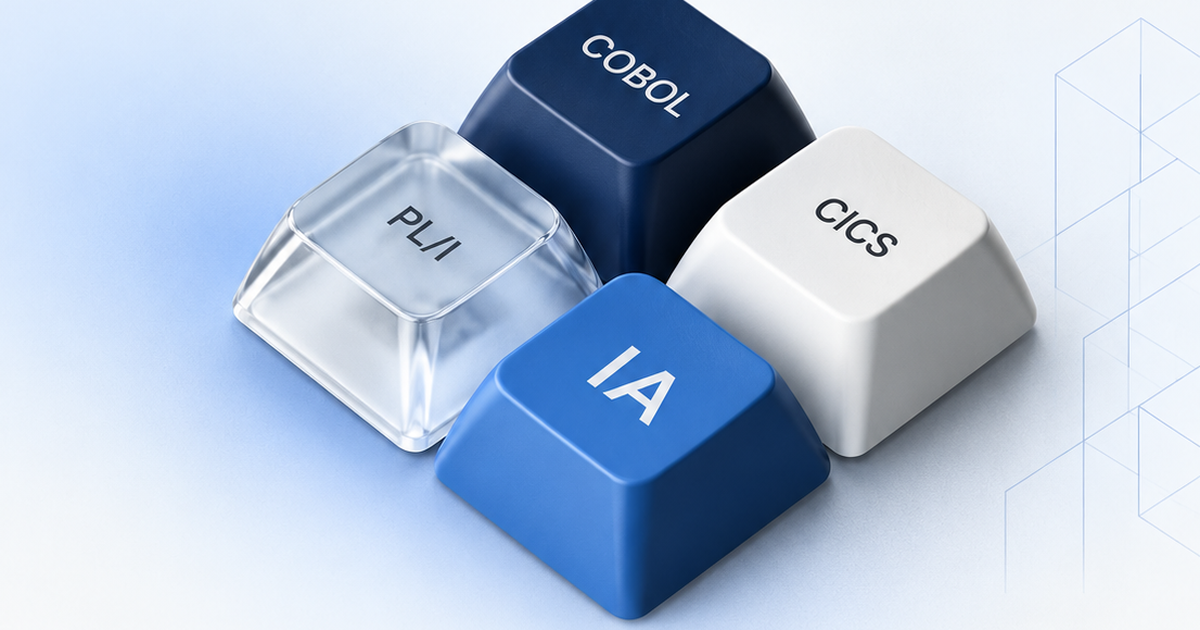
More than just COBOL: business logic is rarely concentrated in one place. It is spread across multiple technology layers, and our extraction accounts for this.
- Application code. COBOL, PL/I, Unibasic, PowerBuilder, Delphi, VB6, legacy .NET: the programs that carry the core business rules.
- Orchestration and transactions. JCL for batch processing, CICS for transactions, BMS screens: how everything executes and links together.
- Data and storage. DB2, VSAM, IMS, and proprietary databases: stored procedures, file structures, and logic buried in the data layer.
To see how these tools compare to traditional approaches, read the difference between traditional AI and generative AI.

What does the RELÈVE offering include?
Three service components that adjust to the maturity and application portfolio of each organization. They can be combined or deployed separately.
Mainframe modernization
AI-extracted specifications, validated by your experts. For each module, an explicit decision: decommission, migrate to a software package, or rebuild from scratch. Code generation is then AI-assisted and reviewed by our architects.
Integration and coexistence
Real-time replication, data lakes, and encapsulating COBOL routines into web services allow you to connect your applications without modifying existing structures. Coexistence between the old and the new remains controlled throughout the transition.
Application portfolio management
Automated inventory and documentation of the portfolio, categorized by business domain, complexity, criticality, and dependencies. This high-level overview informs a multi-year roadmap and the accompanying governance.
How does the RELÈVE process work?
In two stages: first understand, then transform. No decisions are made without specifications validated by your experts.
Understand: The RELÈVE Diagnostic
- Extraction. AI analyzes the source code and produces detailed specifications by module, categorized by domain, complexity, criticality, and dependencies.
- Validation. Your business experts review and validate the specifications. We correct, enrich, and adjust the categorization.
- Decision. For each module: decommission, migrate to an existing system, or rebuild from scratch.
- Roadmap. Prioritized plan: timeline, risks, dependencies, and acquisition of the necessary systems and integrators.
Transform: Execution
- Generation. Code accelerated by AI, reviewed by our experts.
- Quality Assurance. Quality, compliance, security, and performance.
- Deployment. Preparation and support for the production rollout.
- Post-implementation. Knowledge transfer and operational continuity.
The role of the solutions architect remains central at every stage: the AI proposes, the architect decides.
What does RELÈVE change for you?
Less risk, more speed, and knowledge that stays within the organization.
- Reduced risk. Each module is specified, validated, and categorized before any decision is made. No blind transitions.
- Acceleration without compromise. AI handles repetitive analysis and transposition; your experts and ours focus on the validations that matter.
- Preserved knowledge. Business rules buried in decades of code are recovered and documented in plain language, even without original documentation.
- Full traceability. From initial analysis to compliance testing, every decision and every line generated is auditable.
We don't rewrite blindly: we extract, we validate, then we decide.
What concrete evidence already exists?
This is not a theoretical approach: here are excerpts from work already delivered by PlanAxion on existing systems.
- Unibasic legacy system. Reverse engineering of a system with no documentation and full recovery of business logic buried in decades-old code.
- Modern C# and .NET code. Extraction of functional specifications, decoupling of application logic from the platform, and porting from Windows to Android—100% AI-generated and reviewed by our architects.
- Typical deliverables. Module-by-module specification documents, state transition specifications, dependency and call mapping, and application portfolio categorization.
Where do the AI tools run and what happens to your data?
Your data remains under your control: three deployment modes are available, and the same governance and security framework applies to all three.
- Your sovereign environment. AI tools run on your premises; code and data never leave your perimeter.
- Your approved AI environments. We work within platforms already authorized by your organization, such as dedicated cloud instances.
- PlanAxion-managed environment. An isolated workspace, set up according to your security and compliance criteria, to get you started quickly.
The RELÈVE governance framework covers regulatory compliance, sensitive data control, full project traceability, and process auditability. Both automated and human validations are tailored to your internal standards rather than externally imposed.

Which platforms should a legacy system be migrated to?
Each target is chosen with you, module by module, never imposed. The legacy technologies we encounter most often are COBOL and PL/I on mainframes (JCL, CICS, BMS), Unibasic, PowerBuilder, Delphi and VB6, MS Access applications, older Java and .NET, as well as data stored in DB2, VSAM, IMS, or proprietary databases.
Modernization paths generally fall into a few categories.
- Software packages and existing solutions, when migration is better than rebuilding.
- Modern Java, .NET, Python, or TypeScript, when custom rebuilding is necessary.
- APIs, microservices, and routines encapsulated as web services, to open up existing systems without rewriting them.
- Cloud (Azure, AWS, GCP) or sovereign hosting, depending on your requirements.
- Real-time replication, data lakes, and living documentation that is generated and then maintained.
Why entrust this modernization to PlanAxion?
The rigour of a large integrator, the agility of a boutique firm, and the strength of an ecosystem. PlanAxion is a founding member of Axonal, a leader in artificial intelligence in Quebec that brings together three complementary areas of expertise: Baseline for artificial intelligence, Paragon Faction for technology and data management, and PlanAxion for process optimization and project management.
Together, the ecosystem represents over 188 clients and more than 276 projects.
- Proximity and commitment. A leadership team involved in every mandate, quick decision-making, and a direct relationship.
- A pool of qualified experts. Our placement practice gives us rapid access to hard-to-find profiles: architects, analysts, and specialists in legacy technologies.
This practice extends our AI Workshop, which helps organizations prioritize their AI use cases in four weeks. To compare the formats available in Quebec, read how to choose an AI workshop.
Where to start: the RELÈVE Diagnostic?
Through a progressive and practical approach, in just a few weeks, at a flat rate and with no obligation for the next steps. The results speak for themselves, whether you continue with us or not.
- Choose 2 to 3 representative modules, of varying complexity and nature, to test the approach in real-world conditions.
- Launch extraction and evaluate: in a few weeks, you will have concrete specifications that your business experts can evaluate directly.
- Map the architecture and master data: an inventory of existing technologies, migration patterns, and support systems.
- Decide based on concrete facts: you will then have everything you need to plan the next steps with confidence.
You walk away with:
- validated specifications for the pilot modules;
- a categorization of your portfolio by domain, complexity, and criticality;
- a map of the architecture and migration patterns;
- a decision for each module: decommission, migrate, or rebuild;
- a prioritized roadmap and a budgetary order of magnitude.
Let’s pass the torch together. The process happens in three stages: a 45-minute meeting to understand your application portfolio and priorities; a RELÈVE Diagnostic on 2 to 3 pilot modules, including extraction, validation, and mapping; and finally, an informed decision where you choose the path forward, either with us or with the deliverables in hand. Schedule a 45-minute meeting.
Frequently asked questions
What is a legacy system?
A legacy system is an application still in production but built on older technologies such as COBOL, PL/I, Unibasic, PowerBuilder, VB6, Delphi, MS Access, or older versions of Java and .NET. It often supports critical processes, is expensive to maintain, and relies on skills that are becoming increasingly rare in the market.
Can AI really read COBOL without documentation?
Yes. The analysis starts with the source code itself: models map out modules and dependencies, then describe what each routine does in plain language. The resulting specifications must then be validated by your business experts, which remains the critical step before any transformation.
Do you have to rewrite everything to modernize a legacy system?
No. The decision is made module by module: decommission what is no longer needed, migrate to a software package when it meets the requirement, and rebuild only where justified. Routines can also be encapsulated into web services to open up existing systems without rewriting them.
How long does the RELÈVE Diagnostic take?
A few weeks, covering 2 to 3 representative pilot modules, at a fixed price and with no obligation for the next steps. You walk away with validated specifications, a categorization of your application portfolio, an architectural map, a decision for each module, and a prioritized roadmap with a budgetary order of magnitude.
Where do the AI tools run and what happens to our data?
You choose from three modes: your own sovereign environment, your pre-approved AI environments, or an isolated environment managed by PlanAxion. In all cases, code and data never leave the agreed-upon perimeter, and the same framework for governance, traceability, and auditability applies throughout the mandate.
- Office of the Auditor General of Canada, Report 7: Modernization of Information Technology Systems (2023)
- The majority of software used by the federal government is obsolete, warns the Auditor General (Le Devoir, October 20, 2023)
- U.S. Government Accountability Office, Information Technology: Agencies Need to Develop Modernization Plans for Critical Legacy Systems, GAO-19-471 (June 2019)