
- According to the Flexera 2026 State of the Cloud Report, managing cloud spend remains the top challenge for 85% of organizations, and 29% of cloud spending is estimated to be wasted.
- According to Gartner, global spending on public cloud services was projected to reach $723.4 billion USD in 2025, an increase of 21.5%.
- According to the Institut de la statistique du Québec (2025), 17.0% of Quebec businesses planned to adopt cloud computing in the year following Q2 2025.
- A cloud transition replaces infrastructure management with contract management: cost reduction should never be the primary objective (PlanAxion, 2026).
Your IT director announces that the basement server room is reaching the end of its life. The vendor suggests "moving everything to the cloud." Your controller asks how much it will cost, your legal counsel asks where the data will go, and no one has the same answer. This is exactly where cloud architecture stops being a technical issue.
The market figures cited are from public surveys (Flexera, Gartner, Institut de la statistique du Québec, Verizon) and describe trends, not your specific situation.
According to the Flexera 2026 State of the Cloud Report, managing cloud spend remains the top challenge for 85% of organizations, and the estimated share of wasted cloud spend has risen to 29%, the first increase in five years.
What is cloud architecture and what are its three models?
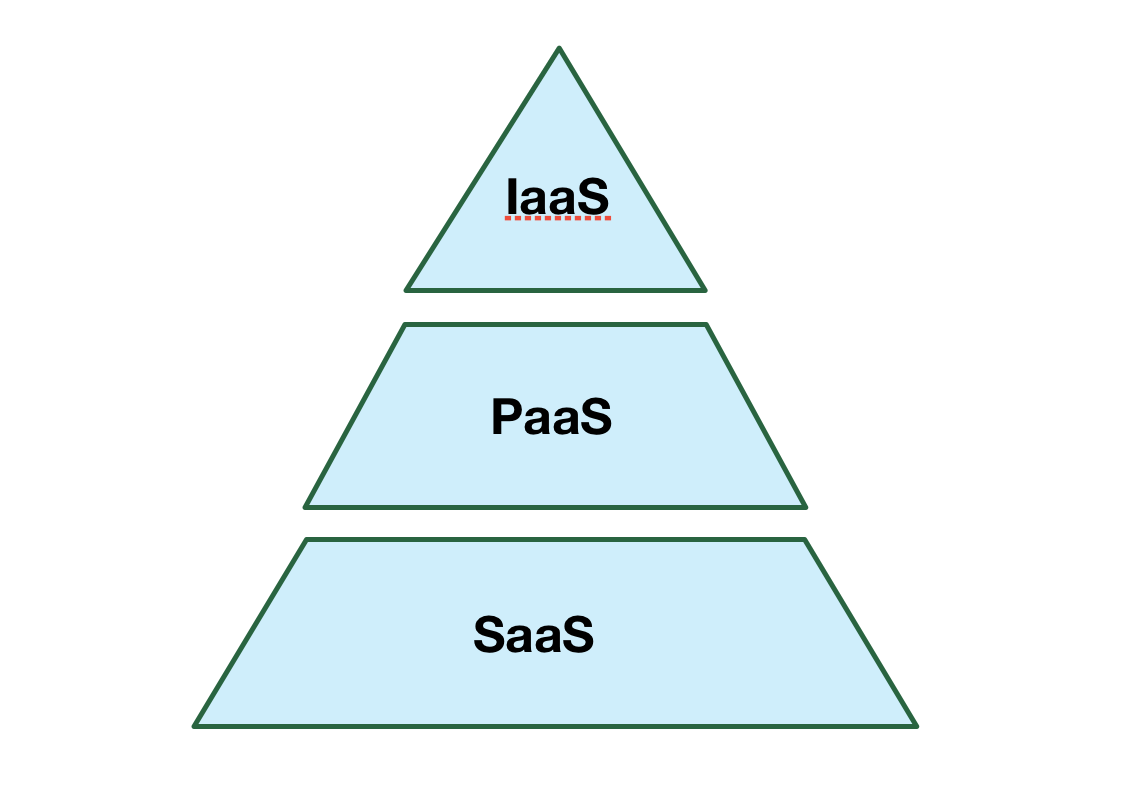
Cloud architecture involves using servers, platforms, or applications hosted by third parties and accessed via the internet, following three models that transfer increasing levels of responsibility to the provider: IaaS, PaaS, and SaaS. Think of them as a pyramid: each level includes the one below it.
IaaS (Infrastructure as a Service). Only virtual servers are hosted externally. Connectivity tools remain within the organization, and your IT administrators and network managers continue to manage the architecture.
PaaS (Platform as a Service). In addition to servers, this includes operating systems, middleware, and the development and analytics tools that allow systems to communicate with each other. You pay for what you use. Developers, system administrators, and database administrators work at this level.
SaaS (Software as a Service). The software itself is cloud-based and users are the only ones involved. A username, a password, and a per-user license: Microsoft 365 or Netflix are examples. Nothing is hosted on your servers, and your data lives in the cloud.
What benefits does the cloud bring to a business?
The cloud offers two main benefits: agility, because the company stops maintaining servers and only pays for what it consumes, and integration, because cloud applications connect more easily with one another. IT teams can then focus their energy on business activities rather than infrastructure management.
The pay-per-use model changes the investment logic. A retailer in Sherbrooke whose sales triple between November and January can rent capacity for three months and then release it. With purchased servers, they would pay all year for their December peak.
Integration is the least marketed but most valuable benefit. Merging two systems, connecting an ERP to a CRM, or feeding an analytics tool: all of this happens faster when applications share the same hosting and interface logic.
What are the impacts of the cloud on IT, finance, and contracts?
The cloud reduces IT infrastructure tasks, makes the CFO a co-owner of the cloud alongside the CIO, and shifts internal expertise toward contract and data management. Believing that the cloud is a magic bullet that is easy to implement is the first mistake.
On IT. Backups and disaster recovery are shifted to specialized providers. The internal team has fewer operational tasks, which requires a review of processes, the development of new expertise, and sometimes a reduction in staff. This transition requires change management that goes beyond a communication plan: training, reassignment, and communications that everyone understands.
On the finance function. The company's CPAs must understand the impacts, model usage-based cost behavior, and analyze integrated data. The CFO becomes a co-owner of the cloud with the CIO, because the variable monthly bill replaces predictable depreciation.
On contracts. Infrastructure management gives way to contract management. Procurement, legal, IT, and finance must negotiate service levels, volume discounts, and renewal terms together. You also need to know where data is hosted and where it transits: in Quebec, Law 25 requires an assessment process before any cloud hosting of personal information.
On finances. The cost structure changes, but reducing operating costs should never be the primary goal, because it is not guaranteed. A case study must quantify recurring costs (licenses, consumption, reduced IT staff) and non-recurring costs: severance pay, recruitment, change management, contract cancellation, data migration, and implementation fees.
Key figures to keep in mind:
- According to Gartner, global spending on public cloud services was expected to reach $723.4 billion USD in 2025 (+21.5%), including $299 billion in SaaS and $211.9 billion in IaaS.
- Gartner predicts that 90% of organizations will adopt a hybrid cloud approach by 2027.
- According to Flexera (2026), 73% of organizations operate in hybrid environments, and 76% of large enterprises spend more than US$5 million per month on cloud services.
- According to the Institut de la statistique du Québec (2025), 17.0% of Quebec businesses planned to adopt cloud computing in the year following Q2 2025, a rate similar to Ontario (17.1%).
Moving to the cloud doesn’t eliminate infrastructure management: it replaces it with contract management.
Is cloud computing secure?
The physical security and intrusion protection provided by major cloud providers exceed what most companies can afford, but the primary risk remains the user: a lost credential or a clicked phishing link is all it takes. Providers of this scale hire recognized experts and implement best practices because their business model depends on it.
The 2026 Verizon Data Breach Investigations Report confirms this: the human factor is present in 62% of analyzed breaches. The same report notes that only 23% of third-party organizations had fully addressed the lack of multi-factor authentication on their cloud accounts.
Logical access (username and password) is the gateway. Losing your laptop, reusing a password, or clicking on a fake Revenu Québec email exposes the entire organization. Team awareness and multi-factor authentication are not optional, especially when some staff work remotely: our advice on cybersecurity for remote work applies directly.
How do you prepare for a successful cloud transition?
A successful cloud transition begins with a company-specific business case that quantifies recurring and non-recurring costs, specifies where data will reside, and identifies IT and finance co-leads before the first contract is signed. The cloud is an enabler, not an objective. Its deployment requires time, preparation, and strategic guidance independent of the vendor selling the migration.
Frequently asked questions
What is the difference between IaaS, PaaS, and SaaS?
IaaS hosts only virtual servers externally; your IT teams manage the rest. PaaS adds operating systems, middleware, and development tools, billed by usage. SaaS delivers the complete application over the Internet, with a per-user license. Each layer transfers more responsibility to the provider and removes it from your internal teams.
Does the cloud reduce a company’s IT costs?
Not necessarily, and that should never be the primary goal. Recurring infrastructure costs often drop, but usage-based licensing, migration, change management, and severance costs add up. According to Flexera (2026), 29% of cloud spending is wasted. A quantified business case is essential before deciding.
Who is responsible for cloud computing in the company?
The CIO and CFO become co-responsible. The former is accountable for architecture and security, the latter for variable costs, contracts, and financial compliance. Procurement and legal departments are brought in to negotiate service levels and data hosting. The cloud is an executive decision, not just an IT one.
Where is data hosted in a cloud architecture?
With the provider, in data centres that may be located outside of Quebec or Canada. You must know the hosting location, transit countries, and applicable intellectual property rules. In Quebec, Law 25 requires a privacy impact assessment before transferring personal information outside the province.
Is cloud computing secure for an SME?
Yes, often more so than a local server room, because major providers have security teams that few SMEs can afford. The risk shifts to the users: according to Verizon (2026), the human factor is present in 62% of breaches. Multi-factor authentication and awareness become the real priorities.
- Flexera, 2026 State of the Cloud Report (press release): cloud spend management as the top challenge for 85% of organizations, 29% of spend wasted, 73% hybrid environments, 76% of large enterprises over $5M per month.
- Gartner, Forecasts Worldwide Public Cloud End-User Spending to Total $723 Billion in 2025: $723.4 billion USD in 2025 (+21.5%), breakdown of SaaS, IaaS, and PaaS, 90% of organizations in a hybrid approach by 2027.
- Institut de la statistique du Québec, Adoption et utilisation de l’intelligence artificielle par les entreprises au Québec en 2024 et en 2025: anticipated cloud adoption rate of 17.0% in Quebec, among the top three planned digital technologies.
- Verizon, 2026 Data Breach Investigations Report: human factor present in 62% of breaches, 23% of third-party organizations having corrected the lack of multi-factor authentication on their cloud accounts.