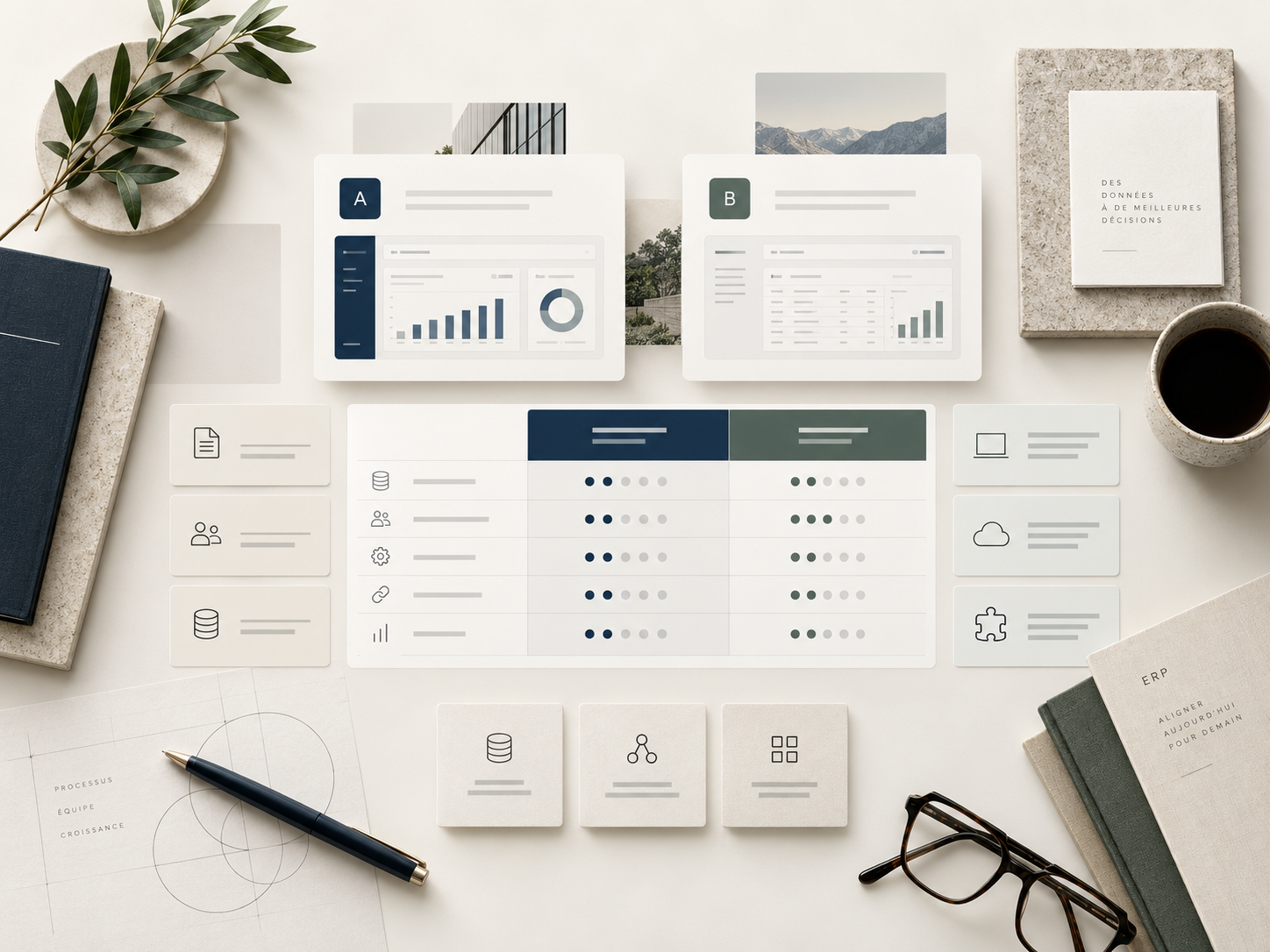
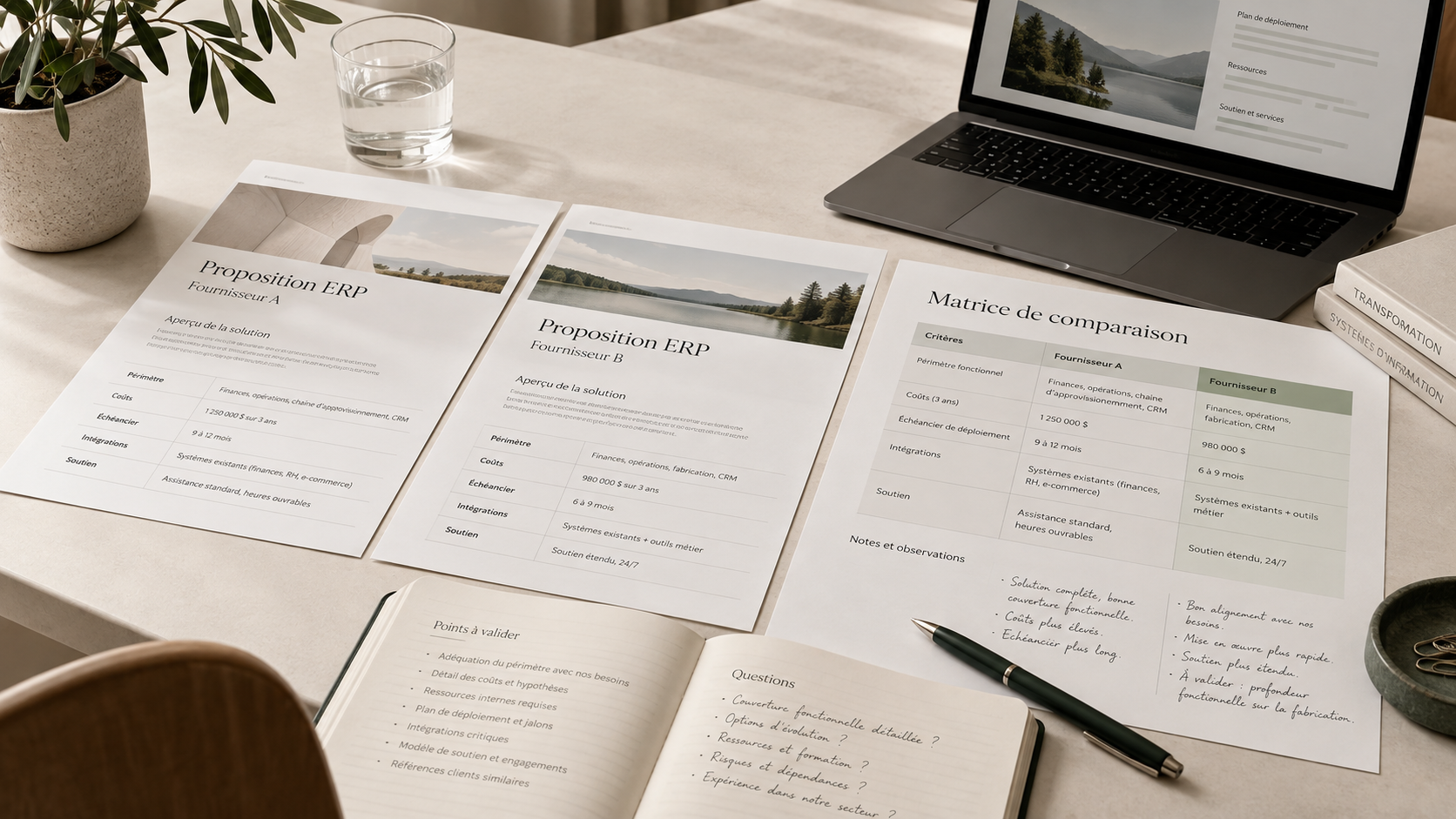
- ERP proposals are only comparable when they use the same scope, assumptions and client responsibilities.
- Evaluate the ERP solution and implementation partner separately.
- Normalize exclusions, internal effort, data, integrations and total cost over a common period before comparing prices.
- Add evidence, gap and risk to the scorecard so sales claims are not scored like demonstrated capabilities.
Two ERP proposals can show very different prices without covering the same project. Before comparing totals, normalize each offer around the same scope, assumptions, exclusions, team, client responsibilities, data, integrations, total cost and risk.
A $480,000 proposal may look more attractive than a $650,000 proposal. But if the first excludes data migration, several integrations, training and post-launch stabilization, the two numbers are not measuring the same thing.
In short: how do you compare two ERP proposals?
Compare at least ten dimensions: included scope, functional coverage, assumptions, exclusions, proposed team, client responsibilities, data and integrations, total cost, commercial terms and unresolved risks.
The number on the first page should never be your primary decision criterion. First make the proposals comparable.
1. Confirm every vendor is pricing the same scope
For each proposal, identify the companies, sites, users, processes, modules, environments, integrations, data work, reports, training and post-launch support included.
An offer covering finance, procurement, sales, inventory, manufacturing, migration, interfaces and training is not equivalent to one covering only finance, procurement, sales and inventory. Normalize the scope first, then compare price.
2. Evaluate the ERP and the implementation partner separately
A strong ERP with the wrong implementation partner is still a project risk. Score the software on functional fit, architecture, security, integrations and usability. Score the partner separately on industry experience, seniority, methodology, availability, governance and references.
A single overall score hides too much. Use the PlanAxion ERP Selection Scorecard to separate solution fit, partner capability and project risk.
3. Compare the assumptions behind each price
Assumptions are where a large share of project risk hides. Look for language such as “the client will provide,” “subject to,” “based on,” or “this estimate assumes.”
For example, a partner may estimate 200 hours for migration while assuming the client will clean, deduplicate and prepare the data beforehand. If that assumption is wrong, both cost and schedule change.
For every material assumption, ask: what happens if this assumption is false?
4. Build an explicit exclusions list
Check historical data, data cleansing, interfaces, EDI, custom reports, testing, change management, training, documentation, support, custom development and knowledge transfer.
An exclusion is not automatically a problem. It simply needs to be visible, understood and priced before the decision.
5. Look at who will actually work on the project
Ask for the people assigned to the engagement. For every critical role, document the name, seniority, ERP experience, industry experience, availability and location.
Also ask whether key resources are contractually committed. The team presented during the sales cycle is not automatically the team that will deliver the implementation.
See PlanAxion's independent ERP consulting approach for the difference between the implementation partner and a client-side advisor.
6. Quantify the effort required from your own team
A lower consulting fee can simply move more work onto your organization. Ask how much effort is expected from your internal project manager, IT team, finance team, operations, process owners and super users.
Example: Partner A expects 2,800 vendor hours and 1,500 client hours. Partner B expects 2,100 vendor hours and 3,000 client hours. Partner B bills fewer hours, but your organization must absorb 1,500 additional hours.
7. Compare integrations and data line by line
Do not accept “migration included” or “integrations included” as sufficient detail. Ask how many, which ones, by what method and to what level of completeness.
For data, review customers, suppliers, products, bills of material, inventory, open orders, financial entries and history. For integrations, review CRM, EDI, e-commerce, WMS, MES, payroll, banking, BI and internal applications.
Two proposals can both say “data migration included” while one covers only master data and the other includes several years of history.
8. Calculate total cost over the same time horizon
Use one common period, such as five years. Include software subscriptions, modules, environments, implementation, development, migration, integrations, testing, training, internal effort, support and ongoing enhancements.
For a broader cost model, see the real cost of an ERP project in Quebec.
A lower-priced proposal is only cheaper if it covers the same project.
9. Identify what is still unknown
Create a clear To confirm category for anything that can still change cost, schedule or the solution decision. Rate each unknown as low, medium or high risk.
A useful rule: no vendor moves into final negotiation while a critical item remains “to confirm.”
10. Compare commercial and contractual terms
Review payment terms, indexation, renewal, commitment period, future licence increases, future hourly rates, travel expenses, ownership of custom work, termination, service levels and the rules governing scope changes.
A large first-year discount can become far less attractive if the agreement materially increases costs in later years.
What scorecard should you use?
A useful scorecard combines weighted dimensions such as functional fit, architecture, data, implementation partner, delivery approach, project risk, total cost, commercial terms and adoption.
Add three columns most comparisons miss: evidence, gap and risk. A 5/5 based only on a sales claim should not be treated the same as a capability that was demonstrated and documented.
Example: the lowest proposal can cost more
Illustrative example: Partner A quotes $525,000 and includes migration, ten interfaces, training, a test environment and 90 days of support. Partner B quotes $430,000 but excludes data cleansing, six interfaces, training and post-launch support.
If those exclusions later add $145,000, Proposal B becomes $575,000 before accounting for additional internal effort or risk. These figures are illustrative and are not market pricing.
12 questions to answer before choosing
- Did every vendor respond to the same scope?
- Are all required modules included?
- Are assumptions explicit?
- Are exclusions known?
- Are all critical integrations priced?
- Does migration cover the data you actually need?
- Is the proposed delivery team identified?
- Is internal effort estimated?
- Is total cost calculated over the same period?
- Are commercial terms comparable?
- Are unresolved items documented?
- Do material gaps have evidence or a resolution plan?
An ERP proposal should support a defensible decision
The goal is not to produce a spreadsheet that automatically selects a winner. Leadership needs to understand why one option costs more, where the trade-offs are, which risks remain, what assumptions influence the budget, who will deliver the project and what still needs to be negotiated.
PlanAxion structures ERP RFPs so vendors answer against the same criteria, scenarios and response format. This makes it possible to evaluate the solution, the implementation partner, total cost and risk separately.
Frequently asked questions
How do you compare the prices of two ERP proposals?
First confirm that they cover the same scope. Then compare total cost over one common period, including licences, services, integrations, migration, extensions, support and internal resources.
Why do ERP proposal prices vary so much?
Vendors may use different assumptions, modules, delivery methods and scopes. A lower proposal may also exclude work that will be billed later.
Should you choose the lowest ERP proposal?
Price should be evaluated with scope, risk, implementation-partner capability, software fit and total cost. A lower offer can become more expensive if important work is excluded or underestimated.
How do you compare two partners implementing the same ERP?
Compare the assigned team, industry experience, seniority, methodology, client responsibilities, references and commercial terms.
Which exclusions matter most?
Pay close attention to data migration, integrations, reporting, testing, training, change management, post-launch support and custom development.
Should the ERP and implementation partner be scored separately?
Yes. Software fit and implementation capability represent different risks and should be evaluated separately.
Primary source: PlanAxion's client-side ERP selection methodology, including scope normalization, assumptions, exclusions, total cost and separate evaluation of the software and implementation partner. See also ERP RFP & Vendor Selection, ERP Selection Scorecard and Independent ERP Selection.