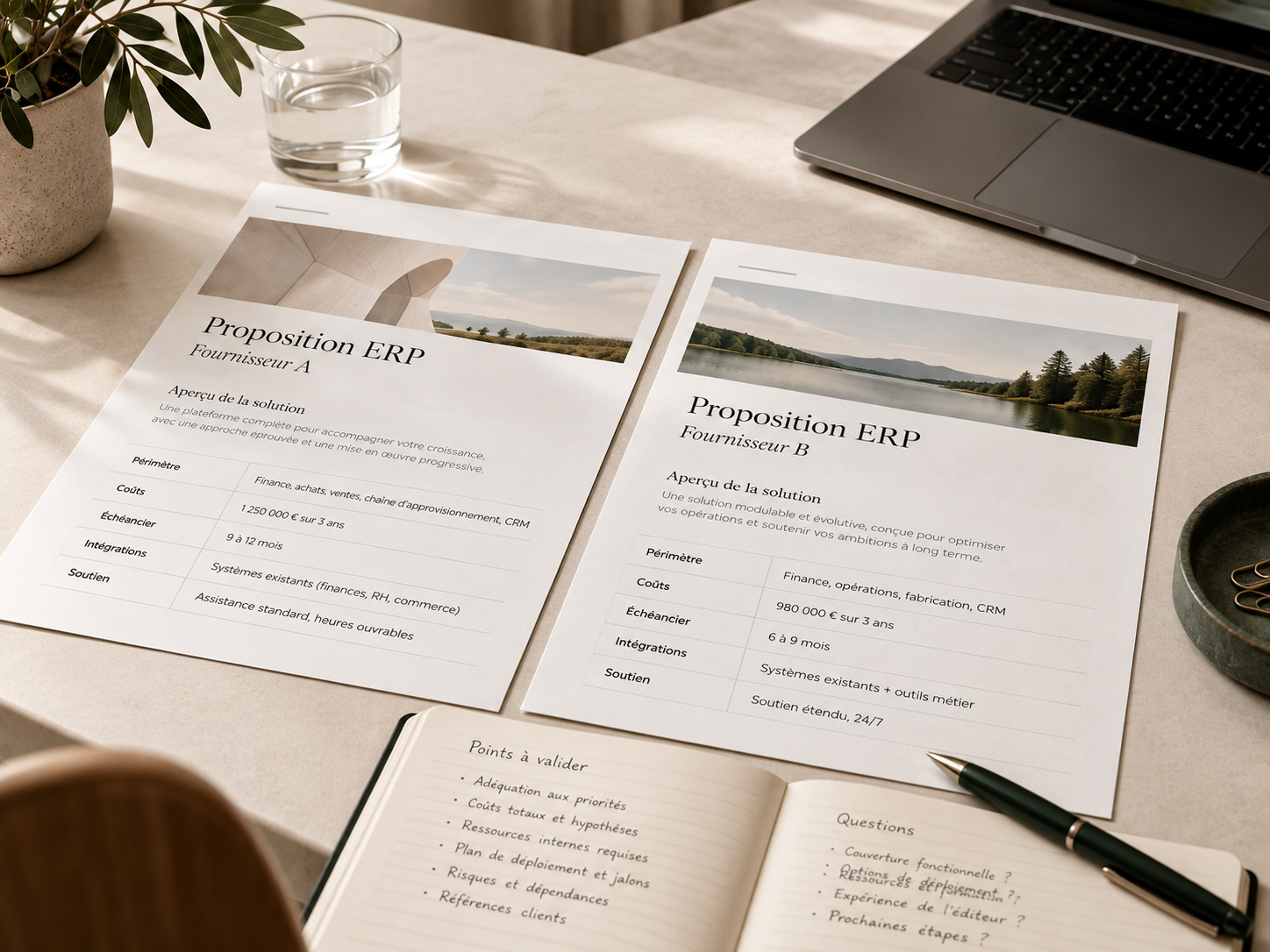

- The contract should define what is included, excluded and considered accepted.
- Scope changes should require explicit approval with cost and schedule impact.
- Data, integrations, service levels, renewals and exit rights should be clear before signing.
- Client-side ERP review complements legal review: the project team validates what the organization is actually buying, while legal counsel validates contractual protections.
An ERP contract should do more than confirm a price and a date. It should explain exactly what you are buying, what the implementation partner must deliver, what your team must provide, what triggers additional fees and what happens if the relationship ends.
ERP agreements are often split across several documents: master agreement, order form, software subscription, statement of work, service levels, security terms, data-processing terms and technical schedules. Risk appears when an important obligation is vague, scattered across documents or missing.
Important: this guide covers commercial, operational and IT review points. It is not legal advice. Applicable clauses and wording should be reviewed by qualified legal counsel for your situation and jurisdiction.
In short: which ERP contract clauses should you review?
Before signing, review at least twelve areas: scope, acceptance criteria, responsibilities, assumptions and exclusions, change control, pricing and future increases, data, intellectual property, integrations, support, renewal and exit rights, plus legal provisions covering liability and disputes.
Every item that is critical to project success should appear clearly in the appropriate contract documents, with an owner, a success condition and a process for dealing with non-performance.
1. Scope and deliverables
The contract or statement of work should define what is actually included: modules, entities, sites, users, processes, environments, reports, data, integrations, testing, training and post-launch support.
Avoid broad language such as “full implementation” without a deliverables list. A useful scope answers three questions: what, by whom and when?
2. Acceptance criteria
A deliverable should not be considered accepted merely because it was submitted. Define the success criteria, who approves, the review period, the correction process and the testing required.
For critical processes, acceptance should be based on an observable result rather than a general impression.
3. Roles and responsibilities
Document the obligations of both the implementation partner and the client: project management, decisions, data, testing, subject-matter experts, training, access and integrations.
A responsibility matrix reduces the risk that essential work falls between teams because each assumed the other owned it.
4. Assumptions and exclusions
Every ERP estimate depends on assumptions. For each critical assumption, ask: what happens to cost, schedule or scope if this assumption is wrong?
Also review exclusions such as historical data, cleansing, interfaces, reporting, training, change management, documentation, testing, support and custom development.
5. Change control
Changes are normal in an ERP project. What should be avoided is a process in which costs can increase without an explicit client-side decision.
The agreement should define who can request a change, who can authorize it, how cost and schedule impact are calculated and whether work can begin before approval.
Connect this process to your client-side ERP governance so scope decisions remain traceable.
6. Pricing, payments and future increases
Do not look only at the initial project price. Review hourly rates, payment terms, expenses, subscriptions, environments, optional modules, indexation and future increases.
If payments are tied to milestones, verify what actually triggers payment: a date, a deliverable submitted or a deliverable accepted.
For a consistent cost baseline, also see the real cost of an ERP project in Quebec.
7. Data, security and portability
The agreement should clarify who controls the data, where it is hosted, how it is protected and how it can be retrieved.
- ownership and usage rights;
- export format;
- retrieval timelines and fees;
- deletion after termination;
- backup and restoration;
- subprocessors;
- incident notification;
- possible use of data by AI-enabled features.
For a cloud ERP, the ability to recover data in a genuinely usable format is a critical exit condition.
8. Intellectual property and custom development
If your organization pays for custom development, interfaces, reports or extensions, determine who owns what.
Separate the vendor's pre-existing intellectual property from configuration, custom work, documentation and your rights to modify or maintain those elements.
9. Integrations and interfaces
“Integrations included” is too vague. For every critical interface, define the systems involved, data direction, owner, technical approach, testing, support and recurring costs.
Connections to EDI, WMS, MES, e-commerce, CRM, BI, banks or internal systems can represent a significant share of implementation risk.
10. Support, warranty and service levels
After production launch, who responds when a critical process fails?
Review the stabilization period, support hours, severity levels, response and resolution targets, availability commitments and the remedies available when service levels are missed.
11. Renewal, termination and transition
Plan the exit before you need it. Review the initial term, automatic renewal, notice periods, termination rights, exit fees, transition assistance, data return and transfer of documentation and access.
A clear exit clause reduces dependency if the organization later changes implementation partner, platform or operating model.
12. Liability, insurance and dispute resolution
Limitations of liability, indemnification, insurance, governing law and dispute resolution are legal matters and should be reviewed by qualified counsel.
From the project side, however, your team should identify the operational scenarios it wants protected: data loss, extended downtime, delivery failure, security incidents or service interruption.
The ERP team explains the operational risk. Legal counsel translates that risk into appropriate contractual protection.
Red flags before signing
- scope that is short or ambiguous;
- missing exclusions;
- undefined acceptance criteria;
- billable changes without clear approval;
- migration or integrations described in one line;
- key resources not identified;
- unclear future price increases;
- unclear data or exit rights;
- weak post-launch support commitments;
- contradictions between the master agreement, proposal and statement of work.
PlanAxion's pre-signature checklist
- Does final scope match the selected proposal?
- Does every critical deliverable have an acceptance criterion?
- Are client responsibilities realistic?
- Have the assumptions been validated?
- Are important exclusions visible and priced?
- Does change control require clear approval?
- Are recurring costs and future increases visible?
- Can the data be recovered in a usable format?
- Do custom developments and interfaces have a clear owner?
- Is post-launch support defined?
- Are exit and transition terms workable?
- Has qualified legal counsel reviewed the important legal provisions?
Compare this review with your ERP Selection Scorecard and ERP RFP. A requirement that was critical during selection should not disappear at contracting.
Bring the contract back to the business decision
The contract is the last opportunity to turn promises made during selection into obligations that are clear enough to govern the project.
PlanAxion supports organizations on the client side by reviewing ERP scope, gaps, responsibilities, costs, assumptions and project risks before the final decision. Legal review remains the responsibility of qualified legal counsel.
Frequently asked questions
Who should review an ERP contract?
The review should bring together business and IT leaders, the project team, finance or procurement where relevant, and qualified legal counsel. Each group covers a different category of risk.
What is the difference between a master agreement and a statement of work?
The master agreement generally governs the overall relationship and legal terms. The statement of work usually defines the specific project: scope, deliverables, resources, schedule, assumptions and price. The documents should be read together.
Which ERP contract clauses can cause cost overruns?
The most sensitive operational areas are often scope, assumptions, exclusions, change control, data, integrations and client responsibilities.
Why review exit terms before signing?
Because they determine the conditions for transition if you change implementation partner or platform: data, documentation, access, assistance, timing and cost.
Does PlanAxion provide legal advice on ERP contracts?
No. PlanAxion reviews ERP, commercial, operational, governance, scope and project-risk dimensions on the client side. Legal provisions and wording should be reviewed by qualified legal counsel.
Primary source: PlanAxion's client-side ERP selection and governance methodology. This guide focuses on operational and commercial ERP risk and does not replace legal advice. Related resources: Independent ERP Selection, ERP RFP & Vendor Selection, ERP Selection Scorecard and Client-Side ERP Governance.