
- Fusion Cloud ERP, E-Business Suite and NetSuite are different products.
- Oracle ERP, SCM and HCM are distinct application families.
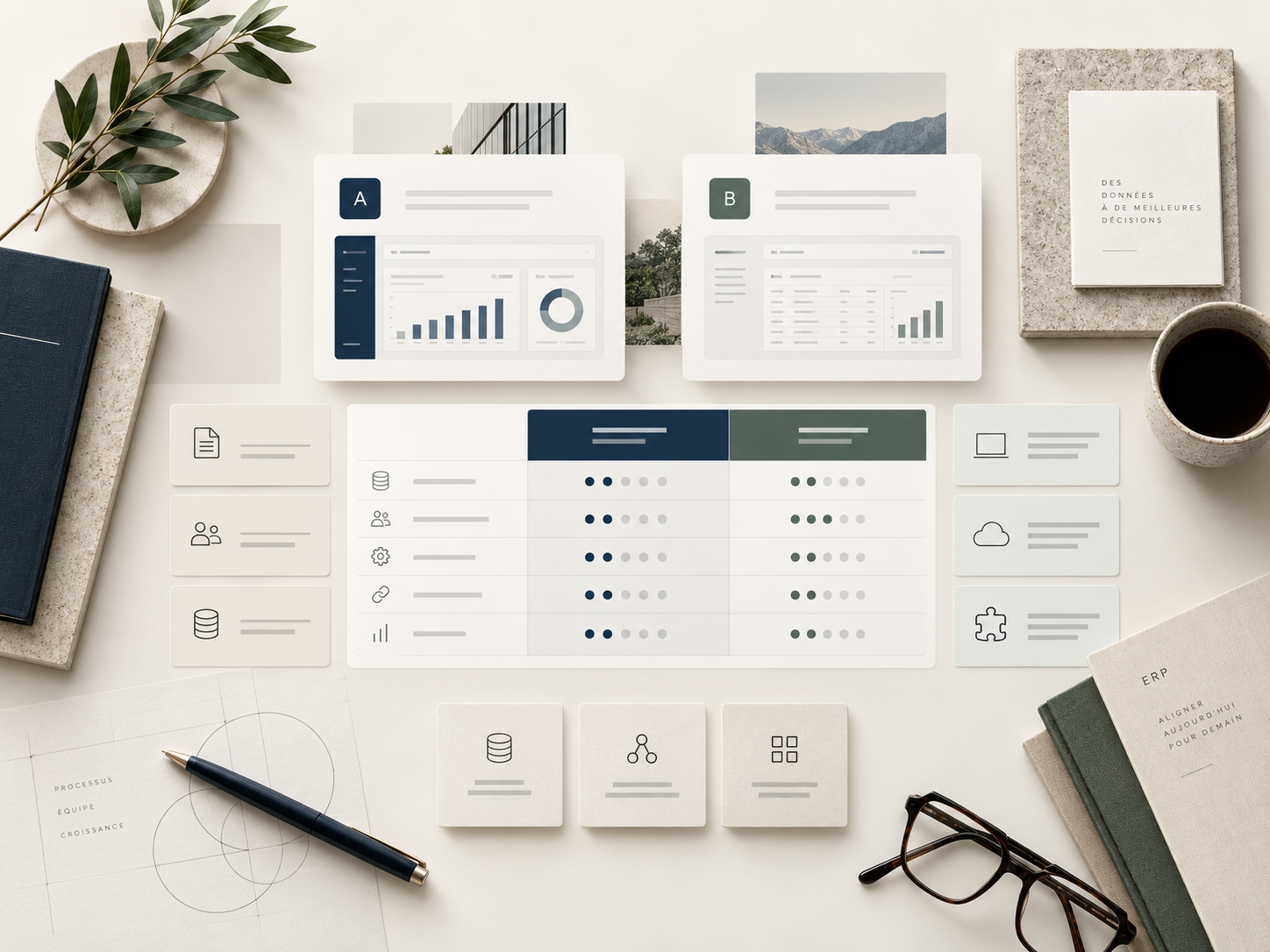
- Compare real demonstrations, scope, responsibilities and five-year total costs.
- Keep decision ownership on the client side.
Choosing Oracle ERP commits a business to years of spending, internal effort and operational decisions. Before meeting an implementation partner, leaders should identify the exact Oracle product, the workflows it must support and what the contract actually includes. These twelve questions help Quebec companies make a defensible decision without giving up control of the program.
Before requesting prices: four scoping questions
1. Why change or replace the current ERP now?
Start with measured problems: slow financial close, duplicate data entry, inaccurate inventory, manual integrations or complex consolidation. Improving the current system may remain an alternative. Evidence to request: a prioritized problem register with current measures, accountable owners and target outcomes.
2. Which Oracle product are we actually discussing?
Oracle Fusion Cloud ERP, Oracle E-Business Suite (EBS) and Oracle NetSuite are distinct products. Fusion Cloud ERP is a cloud application suite. EBS can remain on customer-managed infrastructure or run on Oracle Cloud Infrastructure. NetSuite is another cloud ERP product. Hosting EBS in OCI is not the same as implementing Fusion Cloud ERP. Evidence: product name, edition, operating model, subscription or licence scope and contractual exclusions.
3. Which critical scenarios must work in the first phase?
For distribution: complex orders, inventory allocation, returns and reconciliation. For manufacturing: production, costing, procurement, traceability and financial close. For multi-entity businesses: consolidation, currencies, approvals and segregation of duties. Evidence: a demonstration using your real-world data, exceptions and volumes rather than a vendor's generic script.
4. Which applications are part of Oracle ERP, and which are separate?
Oracle Fusion Cloud ERP covers applications such as Financials, Procurement, Project Management and Risk Management. Oracle HCM and SCM are separate suites that can integrate with ERP. You do not need to buy every Oracle Fusion application. Evidence: a named module list, with each component mapped to an approved business need.
Before the proposal: four delivery questions
5. Which processes can follow standard features?
Justify every proposed customization with a genuine requirement or measurable operational benefit. Compare the lifetime cost of changing software with changing the internal process. Evidence: a fit-to-standard decision log showing owners, alternatives, one-time cost and ongoing impact.
6. What data must be cleansed and migrated?
Review charts of accounts, balances, customers, vendors, items, permissions and historical records. Separate information needed at launch from history that can remain accessible in the legacy environment. Evidence: an inventory, migration mapping, conversion rehearsals and signed reconciliations.
7. Which integrations are critical to operations?
Banks, payroll, e-commerce, warehouses, manufacturing systems and reporting platforms must not be discovered as exceptions after contracts are signed. Evidence: an interface inventory listing data flows, frequencies, error handling, ownership and integrated testing scenarios.
8. How are Canadian and Quebec-specific requirements tested?
Verify applicable tax workflows, Canadian finance, working languages, user access and privacy obligations. When personal information may be communicated outside Quebec, assess applicable privacy impact and contractual requirements. See the Commission d'accès à l'information du Québec guidance. Evidence: signed requirements from finance, IT and privacy owners.

Before signing: four financial and governance questions
9. What is the full five-year cost?
An Oracle price list does not represent the project budget. Separate subscriptions, implementation services, process design, data conversion, interfaces, training, internal staff, testing, support and future changes. The Oracle ERP advisory page explains why client-side governance matters. Evidence: five-year estimates using an identical scope, with explicit assumptions and exclusions.
10. Who decides, delivers and accepts each milestone?
Financial and IT leaders need named owners for approvals, integrations, reports and acceptance criteria. Do not discover after the fact that a control is outside the vendor's scope. Evidence: a responsibility matrix, escalation process and approved decision register.
11. What constitutes successful testing?
A high test-execution percentage alone does not prove that financial close, exceptions or critical integrations will work. Separate functional, end-to-end, performance, security and user acceptance testing. Evidence: signed scenarios, severity-ranked defects and documented launch criteria.
12. Under which conditions would we postpone launch?
Define non-negotiable blockers before production: unreconciled data, missing access controls, failing interfaces, untrained users and an untested rollback plan. Evidence: a production decision checklist and a stabilization plan with accountable owners.
Two examples, different decisions
Fictional example: a 160-person Quebec distributor. Inventory accuracy and billing errors are the main issues. It must demonstrate end-to-end order and stock scenarios, then compare Oracle with other eligible ERP options. Brand recognition is not evidence of fit.
Fictional example: a 280-person manufacturer already using Oracle EBS. The decision involves assessing existing customizations, interfaces and production dependencies before comparing retaining or hosting EBS with a functional move to Fusion Cloud ERP. These illustrations are not real PlanAxion case studies.
Warning signs before signing
- The vendor cannot demonstrate the three most critical workflows.
- Data conversion, integrations and testing are not priced separately.
- Named delivery resources and responsibilities are missing.
- The organization cannot explain what would block production launch.
- Oracle is selected without a defensible comparison of viable alternatives.
PlanAxion offers independent ERP selection support and client-side Oracle ERP advisory to help businesses evaluate the evidence and retain decision control without reselling Oracle licences.
FAQ before choosing Oracle ERP
Are Oracle ERP and NetSuite the same software?
No. Oracle Fusion Cloud ERP and Oracle NetSuite are distinct offerings. Compare their functionality, delivery approaches and contracts against your business processes and organizational structure.
Must Oracle E-Business Suite be replaced to move to the cloud?
Not necessarily. Oracle E-Business Suite can run on Oracle Cloud Infrastructure without becoming Oracle Fusion Cloud ERP. Compare infrastructure hosting changes with a functional ERP transformation.
Which Oracle modules does a midsize company need?
There is no universal module list. Oracle ERP includes areas such as finance, procurement and project management. HCM and SCM are separate, integrable application suites. Let business scenarios determine the scope.
How should we compare Oracle proposals?
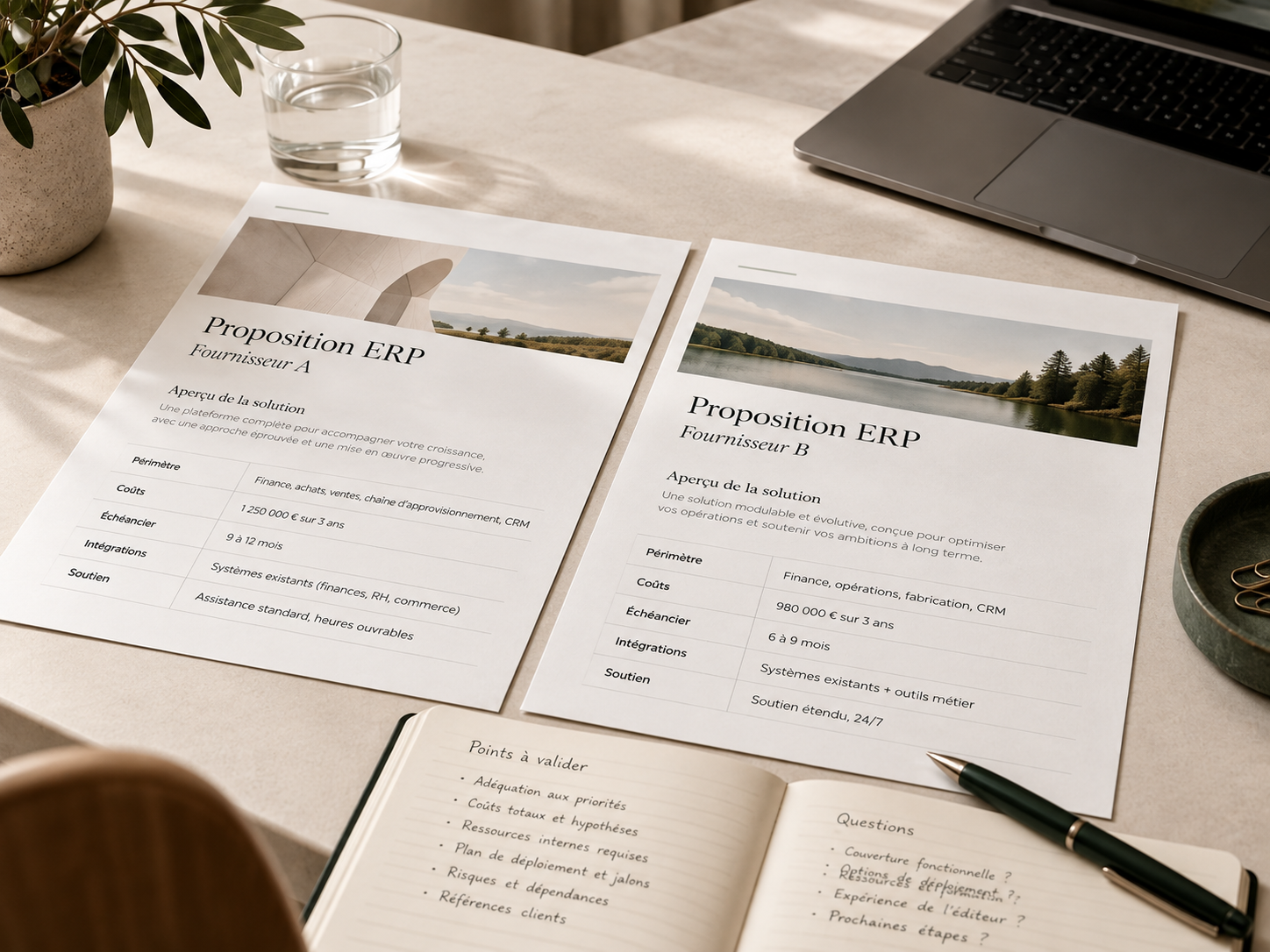
Issue a common scope covering entities, modules, data, integrations, scenarios, ownership, testing and stabilization. Compare exclusions, named delivery personnel and five-year total cost.
- Oracle Fusion Cloud Applications documentation (ERP, HCM and SCM product families).
- Oracle E-Business Suite and cloud deployment options.
- Oracle NetSuite documentation.
- Commission d'accès à l'information du Québec: privacy obligations.
Illustrative photographs: Olena Kholina / Unsplash (cover), Vitaly Gariev / Unsplash (in the article).